Chain Hotel Butter Cookies: Solving Portion Waste with 10g Cocoa Thin Crisp Pieces
Date: 2026-10-29 Categories: FAQ Hits: 385
Chain Hotel Butter Cookies: Solving Portion Waste with 10g Cocoa Thin Crisp Pieces
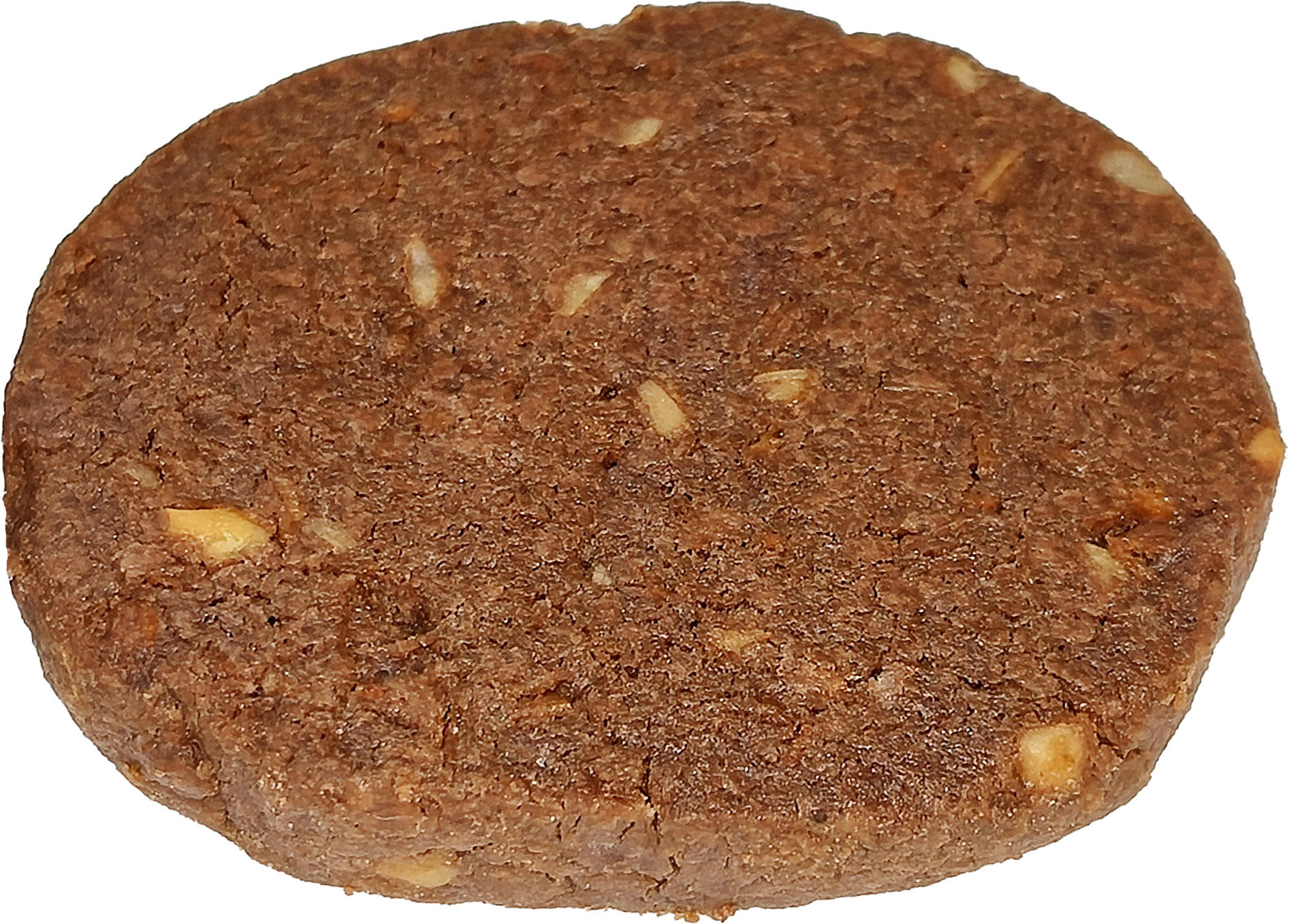
Cocoa Butter Thin Crisp Cookies: 10 g per piece, 9 pieces per box or 13 pieces per can. Product image: SHANGFAN FOOD.
In chain hotel and coffee shop operations, butter cookies are bought by the tin and served by the piece. That mismatch — bulk purchasing measured against piece-level plating — is where portion waste begins. Cocoa Butter Thin Crisp Cookies from SHANGFAN FOOD (Dongguan Shangfan Food Co., Ltd.) address the mismatch with a fixed 10 g piece, packed 9 pieces per box or 13 pieces per can, so a breakfast plate, an afternoon tea set, or an in-room amenity tray can be assembled by counting rather than by estimating.
This article explains what portion waste looks like in a hotel or coffee program, why the problem persists even when buyers specify butter cookies carefully, how the 10 g thin crisp format is built and specified, and what a property or chain needs to do internally to switch to it without disrupting service. It is written for food and beverage managers, purchasing teams, and coffee shop operators who are at the research stage: still comparing formats, not yet locked into a supplier.
What Portion Waste Actually Looks Like in a Hotel Cookie Program
Portion waste is the gap between the cookie mass a program pays for and the cookie mass that reaches a guest in a consistent, presentable form. It is not the same as spoilage or breakage, although both contribute to it. It appears in three repeatable patterns.
1. Over-serve by convention
When a cookie is large, staff plate fewer pieces but larger ones, then add a second piece when the plate looks thin. The guest receives more cookie than the menu assumed, and the kitchen's yield per tin falls below the purchasing plan. Because the plate is built by eye, the over-serve is rarely recorded as a cost line.
2. Variance between shifts and between properties
A chain hotel's breakfast service may be run by three different shift teams across a single week, and by different property teams across a portfolio. If the portion rule is "a few cookies per plate" rather than a fixed count, plate appearance drifts. The guest experience becomes property-dependent, which is the opposite of what a chain brand is trying to protect.
3. Residue at the end of a service window
Open packaging left at a buffet or coffee counter exposes the product to humidity and handling. Once a pack is opened and only partly used, the remainder is either discarded or carried to the next service with reduced texture quality. Smaller, countable units make the remaining stock visible and the discard decision explicit.
The common thread is that these patterns are all driven by the piece, not by the recipe. A butter cookie can be excellent and still be a poor operational fit if its unit weight is larger than the service moment requires.
Why Portion Size Became a Hospitality Sourcing Question
Butter cookies are a mature category, and most of the formats sold into retail were designed for gifting and sharing, not for plated service. The category's commercial weight explains why those formats dominate supply.
- Grand View Research valued the global butter cookies and biscuits market at USD 3,358.3 million in 2024.
- Dataintelo estimates that Asia Pacific held a 34.2% revenue share of the butter-based cookies market in 2025 — the region where a large share of hotel and coffee chain openings are concentrated.
The two figures measure different scopes, which is worth noting for anyone comparing reports: Grand View Research tracks a narrow butter-cookie and biscuit definition, while Dataintelo's USD 42.8 billion estimate for 2025 includes broader categories such as shortbread and sandwich cookies. Neither number should be used to size a single hotel account, but together they confirm that buyers have a deep, competitive supplier base to choose from — which means format, not availability, becomes the differentiating decision.
Two structural influences reinforce the shift toward portion-level thinking.
Standardisation pressure. In the Chinese market, GB/T 20980-2021 sets quality requirements for biscuit and cookie-type products, giving buyers a reference point when specifying product. Where a chain sources across regions, a written specification tied to a recognised standard is easier to audit than a subjective description of appearance.
Label and packaging scrutiny. The EU General Product Safety Regulation (GPSR) 2024 tightened traceability expectations for non-EU manufacturers supplying the EU, and Commission Regulation (EU) 2024/3190 restricts bisphenol A in food contact materials, including packaging linings. Hotel groups that operate cross-border procurement increasingly pass these expectations down to food suppliers, which pushes buyers toward suppliers who already hold recognised food safety certifications.
Against that background, a hospitality buyer's question has shifted from "which butter cookie tastes best" to "which butter cookie fits the service unit we actually plate." The 10 g thin crisp is one answer to the second question.
The 10 g Cocoa Butter Thin Crisp Format, Specified
Cocoa Butter Thin Crisp Cookies are a thin, crisp butter cookie in the cocoa family, built at a fixed unit weight so that portion counting replaces portion estimating. The specification is short enough to place directly into a purchase agreement.
| Specification field | Cocoa Butter Thin Crisp Cookies |
|---|---|
| Product name / model | Cocoa Butter Thin Crisp Cookies |
| Unit weight | 10 g per piece |
| Pack format | 9 pieces per box / 13 pieces per can |
| Shelf life | 5 months |
| Ingredients | Wheat flour, butter, white granulated sugar, crisp flakes, macadamia nuts, cocoa powder, whole egg liquid |
| Imported components | Caramel crisp flakes imported from Europe; high-fat natural cocoa powder imported from Southeast Asia |
| Intended channels | Supermarkets, chain hotels, bakeries, coffee shops, instant retail platforms |
What the ingredient build contributes
Three ingredients in this formula are positioned as the flavour carriers, and each has a functional reason to be there rather than a decorative one.
European caramel crisp flakes supply the crunch layer and a caramel sweetness that reads distinctly against the cocoa base. In a 10 g piece, the crunch is the dominant texture cue — a thin crisp cookie has very little crumb volume, so the inclusions carry most of the eating experience.
Macadamia nuts add nutty depth and body. In a thin format, nut inclusion also slows the perception of the cookie as "light" or insubstantial, which matters when a single 10 g piece has to hold a plate on its own.
High-fat natural cocoa powder imported from Southeast Asia supplies the cocoa identity of the product. Cocoa powder is the ingredient that distinguishes the cocoa thin crisp from the plain Crispy Thin Butter Cookies in the same format family, so the cocoa source is a specification point a buyer can name in the contract rather than a marketing note.
The full ingredient list is wheat flour, butter, white granulated sugar, crisp flakes, macadamia nuts, cocoa powder, and whole egg liquid. Buyers who need to disclose allergens or verify label text should work from this list directly and confirm the label against the finished packaging specification.
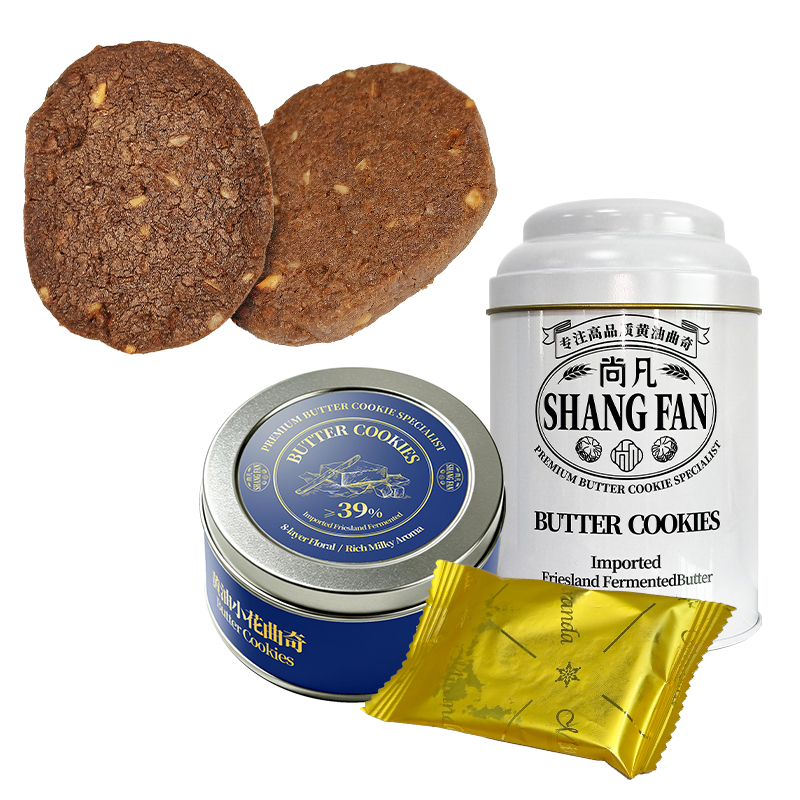
The thin crisp profile: a low crumb volume means inclusions such as caramel crisp flakes and macadamia nuts carry most of the texture.
Where the format is produced
The supplier behind this format is Dongguan Shangfan Food Co., Ltd. (brand: SHANGFAN FOOD), a baked-goods manufacturer established in 2015 and located in Chashan Town, Dongguan City, Guangdong Province, China. The company operates a garden-style factory covering over 10,000 square meters and employs 100 staff, including an R&D team of 5 engineers, with an annual production capacity of 3,640 tons.
Shangfan Food holds internationally recognised food safety certifications including FSSC 22000 and HACCP, and has completed filing for export food business as well as FDA registration. The company's stated main markets are the PRC, EU, USA, South Korea, and Singapore. Its core product range covers Butter Cookies, Lace Butter Cookies, Cranberry Oat Butter Cookies, Crispy Thin Butter Cookies, and Butter Shortbread, and the company states that it can develop and customise products with diversified flavours and varieties according to client requirements.
For a hotel buyer, that combination matters in a specific way: the 10 g thin crisp is not a one-off novelty line inside a gifting catalogue, but part of a thin-crisp format family that also includes Crispy Thin Butter Cookies, Matcha Nut Butter Thin Crisp Cookies, and Oolong Tea Crisp Cookie — all built on the same 10 g / 9-per-box / 13-per-can logic. A chain can therefore standardise its plating rule across flavours rather than renegotiating portion sizes for each SKU.
Step-by-Step: Moving a Property to 10 g Portions
Switching formats is an operational change, not just a purchasing swap. The sequence below is designed so that a food and beverage team can run it without guessing at any stage.
Step 1 — Measure what a plate costs today
Weigh the cookies currently plated at breakfast, afternoon tea, and in-room amenity service. Record the number of pieces per plate and the gram weight per plate, across at least two shifts. The purpose is not to build a precise cost model yet, but to expose the spread between the smallest and largest plate currently served.
Step 2 — Set the served portion rule in pieces, not grams
A 10 g piece only delivers its benefit if the plating standard is written as a piece count. Decide how many pieces constitute a plated portion for each service moment and write it into the service manual. Because the piece weight is fixed at 10 g, a piece count converts directly into a known gram weight without weighing anything at the pass.
Step 3 — Match the pack format to the service moment
Two pack formats exist for a reason. The 9-piece box suits back-of-house and banquet use, where a defined number of plates is being produced from a defined number of packs. The 13-piece can suits front-of-house, minibar, and coffee counter environments, where the container itself sits in view of the guest and needs to hold its shape through a service window.
Step 4 — Run a plating trial across shifts
Plate the 10 g piece against the existing product on the same service line, on the same day. Let at least two shift teams plate independently and compare the results. The question to answer is whether the plate reads as complete — a thin crisp cookie occupies more plate area per gram than a thick cookie, and that visual difference is the most common reason a portion change is rejected by service staff.
Step 5 — Check the shelf life against your stock rotation
Cocoa Butter Thin Crisp Cookies carry a 5-month shelf life. That is shorter than some larger retail formats in the same manufacturer's range — for example, Danish Fancy Butter Cookies 380g is specified at 9 months and Butter Shortbread 680g at 6 months. A property with slow rotation, long inland distribution, or a central warehouse holding buffer stock must confirm the shelf life works inside its rotation before committing. Where rotation is fast — a busy breakfast service, a high-footfall coffee counter — the shorter window is not a practical constraint.
Step 6 — Write the specification into the purchase agreement
Lock the points that define the portion: product name and model, 10 g per piece, pieces per pack, shelf life, and the ingredient list. Anything not written down becomes a variable across future deliveries. Where the buyer needs a supplier-side commitment on food safety, the certification scope (FSSC 22000, HACCP) and export registration should be referenced in the same document.
Use Cases: Where a 10 g Piece Fits
The intended channels for this product are supermarkets, chain hotels, bakeries, coffee shops, and instant retail platforms, and its stated application is the food retail and hospitality industry. Within hospitality, four moments carry most of the volume.
Chain hotel breakfast and afternoon tea
A fixed 10 g piece makes the pastry section of a breakfast buffet countable. Staff replenish by pack rather than by tray, and the portion a guest takes corresponds to a planned unit cost. For afternoon tea sets, where the cookie sits alongside other small items, the thin format keeps the plate balanced instead of letting one large cookie dominate the visual weight.
In-room amenities and minibar
The 13-piece can is the natural fit here. It presents as a sealed unit in the room, protects the thin cookies from crushing during housekeeping handling, and gives the property a defined per-room cost. In-room amenity programs are typically where over-serve is least visible and most persistent, because nobody weighs what leaves a room.
Coffee shop pairing
A 10 g cocoa thin crisp is proportioned against a standard espresso or filter serve rather than against a sharing occasion. That is the operational difference between a cookie sold as a retail tin and a cookie sold as a counter accompaniment: the accompaniment has to be finishable within the drinking time of the beverage. Coffee shops also benefit from a countable unit at the till, because it removes the judgement call on a busy counter.
Banquet, meeting breaks, and catering
Meeting breaks are produced to a headcount. When the portion is a fixed 10 g piece and the pack is a 9-piece box, the catering team can convert a headcount into a pack count arithmetically, without weighing product or estimating yield. This is the single largest operational gain from a fixed-weight format.
Instant retail and food retail shelves
The product is also positioned for instant retail platforms and supermarkets. In that context, the 9-piece box and 13-piece can function as single-serve and small-share formats, and the cocoa thin crisp sits alongside the plain, matcha, and oolong variants of the same format as a flavour range rather than as a standalone item.
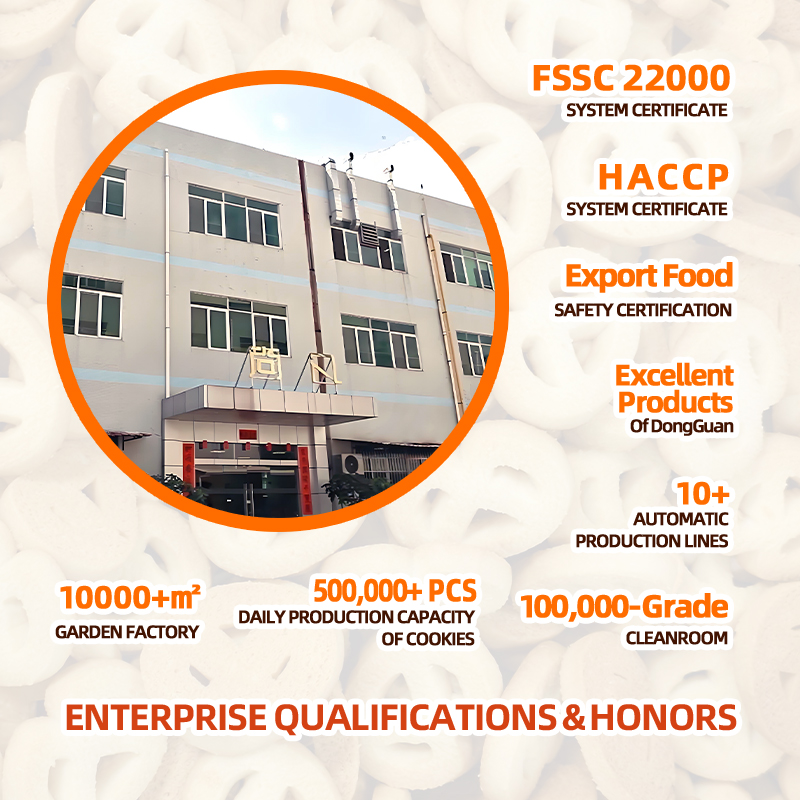
Shangfan Food operates a garden-style factory of over 10,000 m² in Chashan Town, Dongguan City, with an annual production capacity of 3,640 tons.
Comparison Table: Portion Formats in the Shangfan Butter Cookie Range
The table below compares the portion logic of formats available from the same manufacturer. It is deliberately limited to specifications stated in the product data — piece weight, pack counts, net weight, and shelf life — because those are the fields a buyer can verify against a delivery.
| Product | Piece weight | Pieces per unit | Unit net weight | Shelf life | Best-fit service moment |
|---|---|---|---|---|---|
| Cocoa Butter Thin Crisp Cookies | 10 g | 9 per box / 13 per can | — | 5 months | Plated hotel service, in-room amenity, coffee pairing |
| Crispy Thin Butter Cookies | 10 g | 9 per box / 13 per can | 90 g box / 130 g can | 5 months | Same plating rule, plain butter profile |
| Matcha Nut Butter Thin Crisp Cookies | 10 g | 9 per box / 13 per can | — | 5 months | Flavour rotation within a fixed portion rule |
| Oolong Tea Crisp Cookie | 10 g | 9 per box / 13 per can | — | 5 months | Tea-pairing menus, afternoon tea sets |
| Lace Butter Cookies 448g | 16 g | 28 per box | 448 g | 180 days | Sharing and gift presentation |
| Butter Floral Cookies 175g | — | — | 175 g per tin | 5 months | Retail tin and gifting |
| Danish Fancy Butter Cookies 380g | — | — | 380 g per tin, 12 tins per carton | 9 months | Long-rotation retail and gifting |
| Butter Shortbread 680g | — | — | 680 g per box | 6 months | Sharing, family consumption |
Specifications as stated in the product data. Cells marked "—" are not defined in the current published specification for that model.
One comparison is worth spelling out because it is the core of the portion argument. Lace Butter Cookies 448g are specified at 16 g per piece; Cocoa Butter Thin Crisp Cookies are specified at 10 g per piece. Servers who plate by piece count are therefore plating 6 g less cookie mass per unit when they move from the larger piece to the smaller one. Whether that converts into a saving depends entirely on the contracted price per kilogram, which is a commercial term rather than a product fact — but the arithmetic becomes possible only once piece weight is fixed and written down. With a variable-weight piece, the same calculation cannot be closed.
The table also shows the trade-off clearly. The 10 g thin crisp family carries a 5-month shelf life, while Danish Fancy Butter Cookies 380g and Butter Shortbread 680g carry 9 months and 6 months respectively. A buyer optimising purely for shelf life will prefer the larger formats; a buyer optimising for plated consistency will prefer the 10 g formats. Both choices are legitimate, and a mixed portfolio — 10 g thin crisps for service, larger tins for retail and gifting — is a common resolution.
Frequently Asked Questions
Is Cocoa Butter Thin Crisp Cookies suitable for hotel food service and for export markets?
The product is specified for supermarkets, chain hotels, bakeries, coffee shops, and instant retail platforms, with food retail and hospitality as its stated application. The manufacturer, Dongguan Shangfan Food Co., Ltd., holds FSSC 22000 and HACCP certification, has completed filing for export food business, and holds FDA registration; its stated main markets are the PRC, EU, USA, South Korea, and Singapore. Buyers importing into the EU should note that GPSR 2024 places traceability and authorised-representative obligations on non-EU manufacturers, and that EU 2024/3190 restricts bisphenol A in food contact materials — packaging specifications should be confirmed against those requirements at the purchase order stage.
Can a hotel or coffee chain customise the cocoa thin crisp for its own brand?
Shangfan Food states that it can develop and customise products with diversified flavours and varieties according to client requirements, supported by an R&D team of 5 engineers and an annual production capacity of 3,640 tons. The existing thin crisp format family — Cocoa Butter Thin Crisp Cookies, Crispy Thin Butter Cookies, Matcha Nut Butter Thin Crisp Cookies, and Oolong Tea Crisp Cookie — shares the same 10 g piece and 9-per-box / 13-per-can packing, which gives a chain a starting specification to customise from rather than a blank page. Any customisation should be confirmed in writing against the flavour brief, the ingredient list, and the packaging specification.
How should a buyer model cost per plated portion with a 10 g piece?
The mechanism is piece-based rather than weight-based. Because each piece is 10 g and each box holds 9 pieces (13 per can), a headcount converts into a pack count directly: three pieces per guest means three 10 g units, or 30 g per guest, and one 9-piece box covers three guests exactly. Against a 16 g piece, such as the Lace Butter Cookies 448g specification, the same three-piece plate carries 48 g instead of 30 g. The saving or cost depends on the contracted price per kilogram and on how many pieces the current service actually plates — both of which must be measured on site, since price terms are commercial and are not fixed by the product specification.
How do I evaluate samples before committing a property or a chain?
Order samples in both pack formats and run them through the actual service line rather than a tasting room. Plate the 10 g piece against the current product on the same day, let at least two shift teams plate independently, and compare plate appearance, breakage after handling, and how the product holds up once a pack is opened. Because the stated shelf life is 5 months, sample packs should also be checked for condition on arrival. Sample and quotation requests can be made directly with the supplier (contact details below), and the product catalogue is available for download.
What shelf life and ordering cycle should a chain plan around?
Cocoa Butter Thin Crisp Cookies carry a 5-month shelf life, with 9 pieces per box and 13 pieces per can at 10 g per piece. That window suits operations with fast rotation, such as a busy breakfast service or a high-foot traffic coffee counter. Properties holding buffer stock in a central warehouse, or distributing inland over long distances, should map the 5-month window against their actual stock rotation before specifying the format across a portfolio. Confirmed production and delivery lead times should be requested directly from the supplier and written into the purchase agreement, since lead time is a commercial term rather than a product specification.
Conclusion: Portion Control Is a Purchasing Decision
Butter cookies are usually bought as a product and managed as an ingredient, which is why portion waste survives in otherwise well-run hotel and coffee operations. The fix is not a cheaper cookie; it is a cookie whose unit weight matches the unit the kitchen actually plates. A fixed 10 g piece, packed 9 per box or 13 per can, converts plating from a judgement call into a count, and a count is the only thing a multi-property chain can standardise across shifts and sites.
Cocoa Butter Thin Crisp Cookies make that conversion with a defined ingredient build — wheat flour, butter, white granulated sugar, crisp flakes, macadamia nuts, cocoa powder, and whole egg liquid, with European caramel crisp flakes and high-fat natural cocoa powder imported from Southeast Asia — produced by a manufacturer established in 2015 with a 10,000+ m² garden-style factory, 100 staff, 5 R&D engineers, and an annual capacity of 3,640 tons.
The practical next step for a research-stage buyer is narrow: measure the current plate, set the piece rule, and test the 10 g format on a live service line before committing a portfolio. The shelf-life trade-off against longer-life formats should be settled at that same stage, not after the first delivery.

Dongguan Shangfan Food Co., Ltd. — established 2015, Chashan Town, Dongguan City, Guangdong Province, China.
Request a sample or a quotation
SHANGFAN FOOD supplies Cocoa Butter Thin Crisp Cookies at 10 g per piece, 9 pieces per box or 13 pieces per can, for chain hotels, coffee shops, bakeries, and food retail. Sample requests, specification sheets, and quotations are handled directly by the manufacturer.
Email: shangfan168@126.com | Tel / WhatsApp: +86 13392733431 | Web: www.dongguanshangfanfood.com
Product catalogue (PDF): Download the Shangfan Food brochure
Address: Building 3, No.32 Jixing Road, Chashan Town, Dongguan City, Guangdong Province, China.