Butter Cookie Compliance Checklist: Certifications, Labels and Markets
Date: 2026-11-19 Categories: FAQ Hits: 190
Butter Cookie Compliance Checklist: Certifications, Labels and Markets
A butter cookie compliance file is the set of documents a supplier can hand over before the first purchase order. Its job is narrow: to let a buyer confirm that the product, the manufacturing site and the printed label are each covered by something written down. Most files fail in one of three places — the certificate scope, the ingredient declaration, or the net-weight line.
This checklist is for the buyer who has already shortlisted a supplier and now has to read what that supplier emails across. The worked examples come from SHANGFAN FOOD (Dongguan Shangfan Food Co., Ltd.), a butter cookie manufacturer established in 2015 that operates a garden-style factory of over 10,000 m² in Chashan Town, Dongguan, Guangdong, with 100 staff. Real ingredient lists and pack formats make the questions visible; they do not replace your own document review.
Why the certificate is the weakest document in the file
Certificates are the easiest document to forward and the hardest to interpret. A certificate answers four questions: which body issued it, against which standard and version, for what scope, and until when. It does not answer whether your SKU sits inside that scope, whether the formula on the specification sheet matches the formula on the artwork, or whether the label is legal where you intend to sell.
Treat each certificate as an index into the file rather than the conclusion of it. Three matches matter. The site on the certificate must be the plant that will bake your order. The scope must cover the product family and the process actually used. The dates must cover the contract, not merely the first shipment.
What travels with a butter cookie — and what does not
Sweet biscuits move through customs under a classification line, HS 1905.31, and the trade is substantial: world exports of sweet biscuits reached USD 12.3 billion and 3.43 million metric tons in 2024, according to UN Comtrade figures republished in a 2026 HS code guide by FreightAmigo. Classification matters to compliance because the customs description, the ingredient statement and the specification sheet must all describe the same product. When they disagree, the file is incoherent no matter how many certificates it contains.
Regulation itself does not travel with the goods. Two documented examples show why. A U.S. Defense Logistics Agency commercial item description for cookies defines a Style C butter cookie by a distinct sweet-butter flavour, light tan colour, dense texture and varied shape, requires the butter used to be U.S. Grade A or better, and requires processing under current good manufacturing practice with hazard-analysis-based preventive controls referencing 21 CFR Part 117. That is a citable requirement — inside that U.S. procurement context. It is not a universal butter cookie standard, and it cannot be used to grade a retail product sold in Asia.
Second, UK Government guidance on importing confectionery, as captured in the research record behind this article, indicates restrictions concerning products containing dairy from China, and the same record flags that the position must be verified for the specific product and origin before reliance. A butter cookie is a dairy product by construction, so the destination rule — not the supplier's certificate — determines whether it can enter. The compliance file is an input to that market-access decision, never the decision itself.
The file in eight parts
A complete file can be requested as an index rather than as loose attachments, which makes gaps visible before you spend time reading.
- Company identity and site documents. Business licence showing the exact legal name, manufacturing licence or production permit, and the site address that will appear nowhere on the pack but must match every certificate. Where the destination requires them, add the export food business filing record and the U.S. FDA facility registration number. A registration is an administrative listing, not an approval of a product.
- Full food-safety certificates, with complete scope text. Ask for the PDF and any scope annex, not a cropped image of the certificate face.
- Product specification sheet. Ingredient list in the plant's own order, piece weight, units per pack, declared net weight, shelf life, storage conditions, packaging material and barcode.
- Sub-ingredient breakdown. Any ingredient that is itself a mixture — a crisp flake, a chocolate inclusion, a compound coating — needs its own component list, because that is where undeclared allergens hide.
- Allergen matrix across the whole range you intend to buy, plus a written statement on shared lines, scheduling and changeover cleaning.
- Nutrition analysis per 100 g and per piece or serving, because piece-based formats turn serving size into a labelling decision.
- Shelf-life validation and pack-integrity data, explaining why one SKU is stated at 5 months and another at 12, and under what storage condition.
- Traceability and change control. Lot coding, a certificate of analysis per lot, and a contractual obligation to notify you before the formula, an ingredient source, the artwork or a certification status changes.
If any item is missing, ask once in writing and keep the reply. A verbal assurance is not a document, and a scheme certificate the supplier has not actually produced — a retailer-specific audit, an organic certificate, a halal certificate — should be recorded as a gap rather than accepted as a claim.
Reading a certificate against a real record
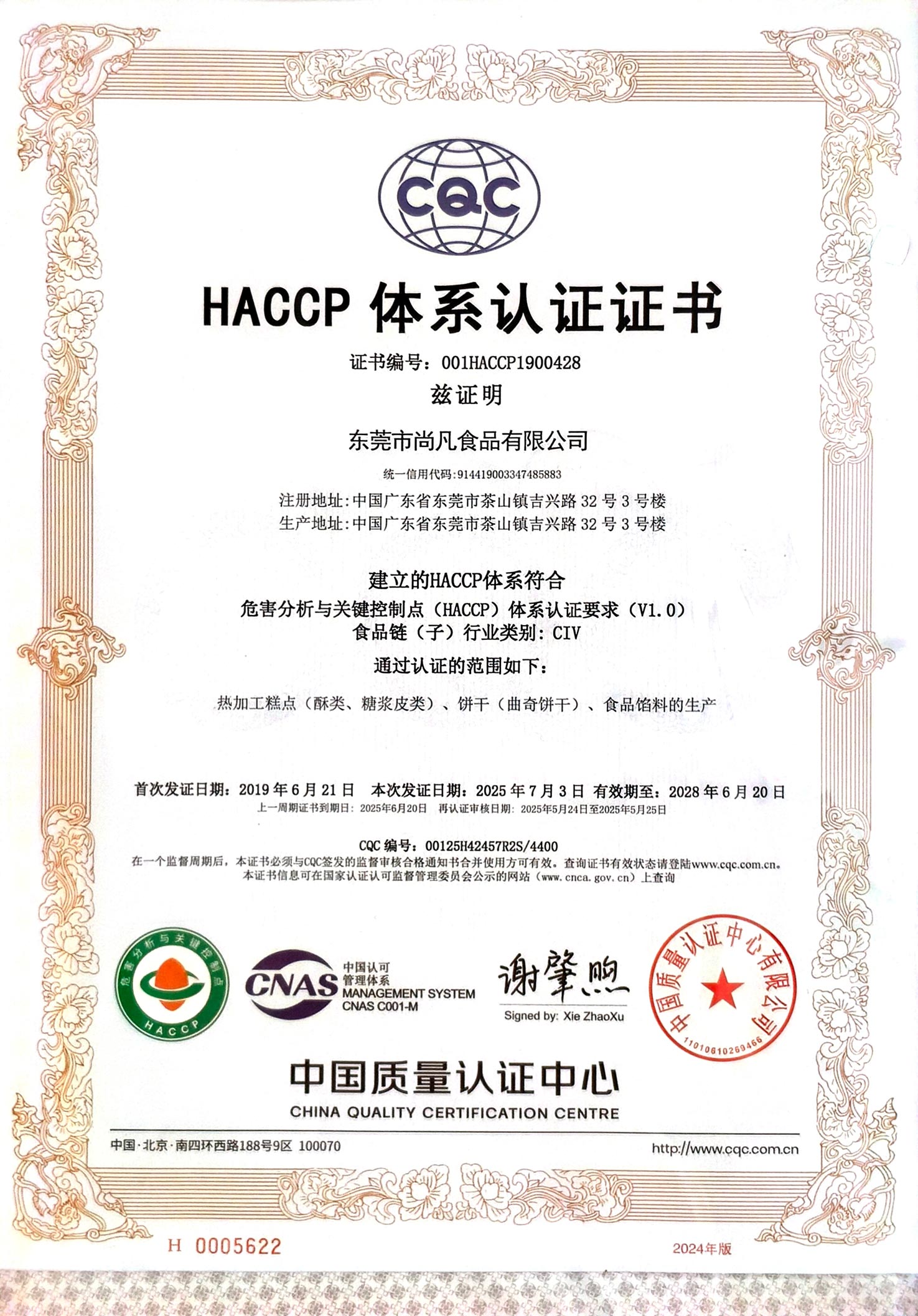
Two certificates in the Shangfan record show how much text a buyer genuinely has to read. The FSSC 22000 entry states Version 6, certificate number 162605010, issued by Intertek on 15 May 2026 and expiring 14 May 2029, covering production of cookies and hot processed pastries (peach pastry) with baking as the main processing step, assessed against ISO 22000:2018, ISO/TS 22002-1:2009 and the FSSC 22000 additional requirements for Version 6. The HACCP entry states certificate number 001HACCP1900428 from China Quality Certification Centre, issued 3 July 2025 and expiring 20 June 2028, against the scheme requirement titled Requirements for HACCP system certification (V1.0), scoped to the manufacture of heat-processed pastries, biscuits and food fillings.
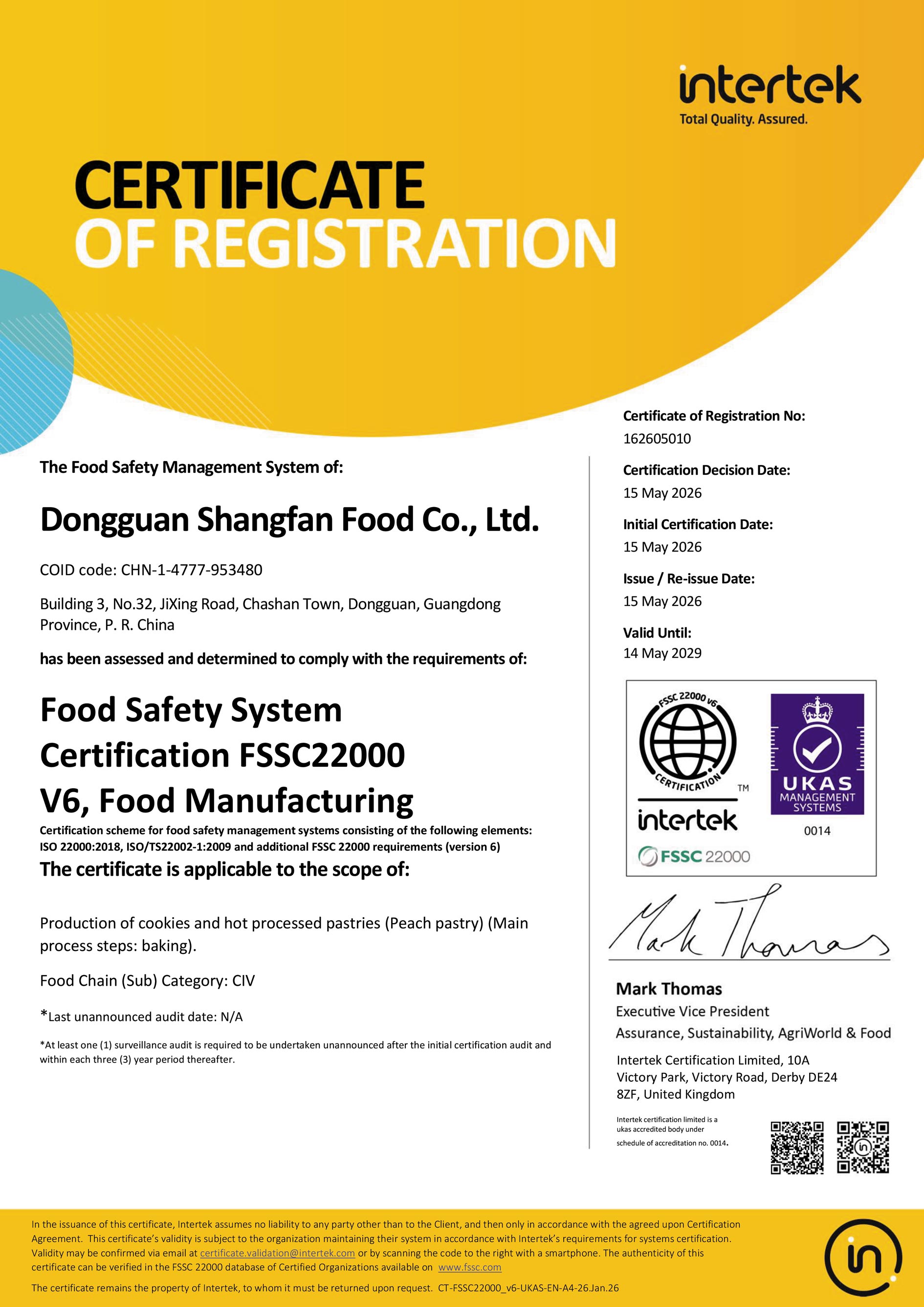
Those records answer five useful questions: who issued, which standard and version, which activity and product family, when issued and when it lapses, and which market the supplier positions it for. Three questions remain open. They do not confirm that the SKU and pack you are buying was produced inside the certified scope — the FSSC wording also references hot processed pastries, which is a reminder to read the scope line literally instead of assuming cookies covers everything on the price list. They do not replace the plant's own hazard analysis and preventive-control summary, an internal document the buyer has to request separately. And they do not remain valid for the life of a contract: a certificate expiring 14 May 2029 will not cover a three-year agreement signed late in 2026 unless renewal, surveillance-audit evidence and suspension notification are written into the supply agreement.
Ingredient declarations: an eight-item worked example
Buyers usually read the file backwards, starting with the certificate and finishing with the label. It works better in the other direction. Take one Shangfan declaration: the Oolong Tea Crisp Cookie lists wheat flour, butter, white granulated sugar, pecans, whole milk powder, oolong tea powder, matcha powder and salt. Eight components, and each one generates a question the file has to answer.
- Order. Where a market requires ingredients in descending order by weight, the sequence is a claim about the formula. The buyer's check is not whether the order looks plausible, but whether the artwork order is identical to the specification sheet order.
- Butter is not a fat blend. Butter is a specific ingredient, and a shortened butter declaration covering a fat blend would be a misdeclaration. Ask for the butter specification: origin, fat content, fermented or not. Shangfan states New Zealand imported natural butter at not less than 32% for the Danish Assorted Cookie Gift Box, and fermented butter from FrieslandCampina Netherlands at not less than 32% for the Coffee Butter Flower. Before repeating either figure on your own artwork, confirm what the percentage is measured against.
- Egg, written two ways. Cocoa Butter Thin Crisp Cookies list whole egg liquid; Crispy Thin Butter Cookies list whole eggs. Both are egg, and the declared name should reflect the form the plant actually uses. Artwork should not silently normalise the two into one wording.
- Dairy, written three ways. Whole milk powder in the Oolong Tea Crisp Cookie, buffalo milk in the Butter Shortbread and butter across the butter-based range are three different dairy inputs with three different supplier specifications. All three matter to a market that screens dairy origin.
- Compound ingredients. Cocoa Butter Thin Crisp Cookies list crisp flakes, described elsewhere in the same record as caramel crisp flakes imported from Europe. A two-word entry like that is precisely where a sub-declaration is needed, because a compound ingredient can carry allergens its short name conceals.
- Characterising powders. Oolong tea powder and matcha powder both appear. Whether a market treats a powder as an ingredient or as a flavouring, and at what inclusion rate, is a labelling question the specification sheet should answer with numbers rather than adjectives.
- Sugars and salt. White granulated sugar and salt in the same list drive sugar and sodium declarations, and a 10 g piece makes per-piece nutrition arithmetic unusually visible on pack.
Where allergens surface
Allergens appear in four places, and the file is only complete when all four agree. The ingredient statement carries the declaration. A contains statement repeats it in the form the destination requires. A shared-line or may-contain statement describes the plant, not the recipe. And the artwork proof is where the first three become legal text. A matrix that covers only the SKU you are buying is not enough when four different tree nuts run through the same range.
| Ingredient as declared | Allergen group typically requiring declaration | Shangfan SKU where it appears |
|---|---|---|
| Wheat flour | Cereals containing gluten | Oolong Tea Crisp Cookie; Cocoa Butter Thin Crisp Cookies; Crispy Thin Butter Cookies; Butter Floral Cookies 175 g; Butter Shortbread 680 g; Coffee Butter Flower 175 g |
| Butter | Milk | All butter-based SKUs in the records cited here, including the oat cookies |
| Whole milk powder | Milk | Oolong Tea Crisp Cookie |
| Buffalo milk | Milk | Butter Shortbread 680 g |
| Whole egg liquid / whole eggs | Egg | Cocoa Butter Thin Crisp Cookies; Crispy Thin Butter Cookies; Cranberry Oat Butter Cookies; Dark Chocolate Oat Butter Cookies |
| Pecans | Tree nut (pecan) | Oolong Tea Crisp Cookie |
| Macadamia nuts | Tree nut (macadamia) | Cocoa Butter Thin Crisp Cookies |
| Walnuts | Tree nut (walnut) | Butter Shortbread 680 g; Dark Chocolate Oat Butter Cookies |
| Almond flakes | Tree nut (almond) | Crispy Thin Butter Cookies |
| Oatmeal | Oats — confirm gluten cross-contact control | Cranberry Oat Butter Cookies; Dark Chocolate Oat Butter Cookies |
Two follow-up questions belong in the same email. First, with macadamia, pecan, walnut and almond all present across the range, ask how production is scheduled and how changeover cleaning is validated, then ask for the written answer rather than the reassuring one. Second, oats are not automatically free of gluten cross-contact, so ask what control the plant applies rather than assuming the oat SKUs behave like the wheat-free lines.
The format decides the net-weight line
Net-weight labelling is decided by the pack format before it is decided by the artwork. Shangfan's thin-crisp range — Oolong Tea Crisp Cookie, Cocoa Butter Thin Crisp Cookies and Crispy Thin Butter Cookies — is specified at 10 g per piece with 9 pieces per box or 13 pieces per can, on a 5-month shelf life. That one specification produces four labelling obligations: a piece weight, a count, a net quantity and a date code.
The arithmetic is a check, not a substitute. Nine pieces at 10 g reconcile to 90 g and thirteen to 130 g, and the declared net quantity on pack must agree with the result, with the count statement as a supplement rather than a replacement. Where average-quantity rules apply, the packer also has to demonstrate that the declared quantity is met across a production lot, so ask how piece-weight tolerance is controlled and recorded.
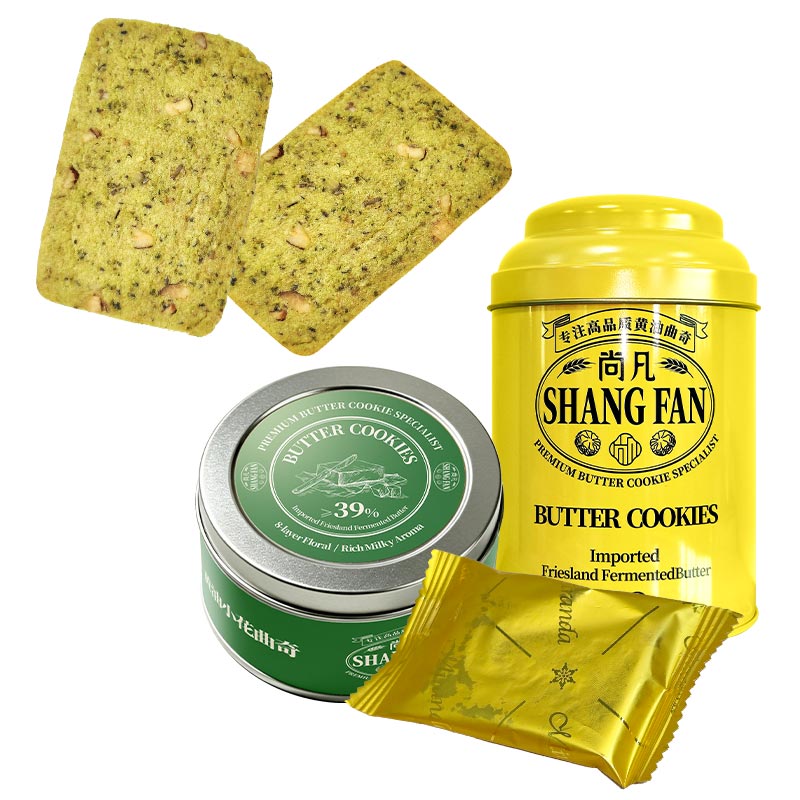
Fixed-weight tins behave differently. Butter Floral Cookies are specified at 175 g with 24 tins per carton, a carton of 44.8 × 30.2 × 24 cm (0.032 CBM), a 5-month shelf life and barcode 6970066564843 for the original flavour. Coffee Butter Flower shares the 175 g × 24 tins carton format but carries barcode 6936832534953 — two products that look alike on a pallet and must never be treated as interchangeable at the label stage.
Gift formats add a second layer. Butter Floral Cookies 260 g come in a gift tin with a matching gift bag and individually packed servings inside, 8 tins per carton on a 6-month shelf life, with a carton of 59.5 × 37.5 × 23.5 cm. Individually wrapped servings usually mean mandatory information must appear on the inner wrapper as well as the tin, which is a question for the destination market rather than a design preference. The Danish Assorted Cookie Gift Box is declared as 760 g across two tins on a 9-month shelf life, and the Salted Cheese Butter Cookies are declared as 32 g × 12 pieces, 384 g per box, on a 12-month shelf life — a count-and-weight pair that reconciles exactly and should be printed as a pair. Butter Shortbread is packed 680 g per box on a 6-month shelf life, and the Butter Cookie Gift Box record states 265 g net weight with a 150-day shelf life for the flower-shaped cookies inside.
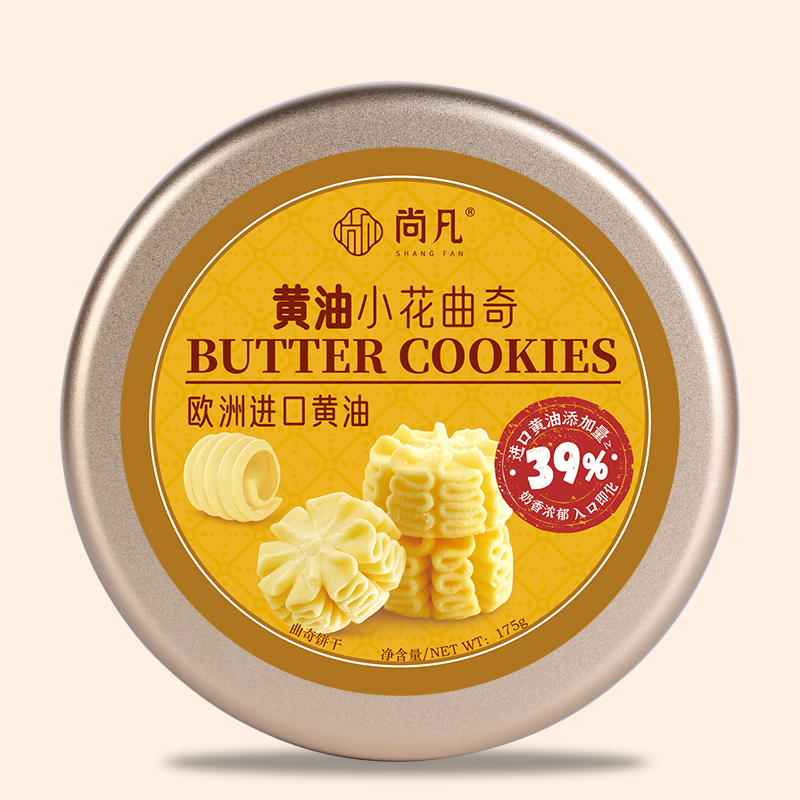
Shelf life is where format and market rule collide. Within one supplier's range the stated shelf lives run to 5, 6, 8, 9 and 12 months, plus 150 days on one gift box. A destination that sets a minimum remaining shelf life at import will treat those SKUs very differently, so the date-marking format and the remaining-life calculation belong in the file for each SKU, alongside the storage condition — for these products, storage away from direct sunlight in a cool, well-ventilated place, with food-contact packaging and humidity control specified to prevent the cookies softening.
Destination requirements to pin down in writing
- The language or languages required on the label, and which party translates and approves.
- The destination allergen list, plus any requirement to emphasise allergens in the ingredient statement.
- Nutrition format and basis — per 100 g, per serving, or per piece.
- Date-marking format and the minimum remaining shelf life accepted at import.
- Dairy-origin documentation and any restriction applying to dairy ingredients from the manufacturing country.
- Who is importer of record, and who owns label approval in law.
- Food-contact packaging compliance, and any registration or pre-market filing required before sale.
Put the answers in the file, dated, and attach them to the contract. A requirement confirmed verbally by a sales contact is not a compliance document.
Ten steps before you sign
- Request the document index first, not individual PDFs, so gaps are visible.
- Match the legal name and site address across licence, certificates, specification sheet and artwork.
- Read the scope line and the standard version, then confirm in writing that your SKU and process fall inside them.
- Check dates against contract length, and ask for surveillance-audit evidence between issue and expiry.
- Compare the specification's ingredient order against the artwork word for word.
- Build the allergen matrix across the whole range you will actually buy, not the single SKU.
- Reconcile piece weight × count with the declared net quantity, then weigh samples from a sealed pack.
- Request shelf-life validation and storage conditions per SKU, since 5-month and 12-month items are not interchangeable.
- Have your importer or broker confirm destination requirements in writing for the specific product and origin.
- Write certificate renewal, per-lot certificates of analysis and change notification into the supply agreement.
What changes by channel
For private-label retail, the file grows an artwork-ownership clause, a barcode-ownership clause and a per-SKU allergen matrix, because the retailer carries the label risk. For gift and hospitality programmes, the multi-component packs matter most: a 760 g two-tin gift set or a 260 g gift tin with individually packed servings inside raises inner-wrapper and outer-carton declaration questions that a single-tin SKU never raises. For export distribution, the file leans on dairy-origin documentation, destination labelling and classification under HS 1905.31, with certificates supplied per shipment rather than once per relationship.
Matching each record to the decision it supports
| Record or claim | What it establishes on its own | What the buyer must still verify |
|---|---|---|
| FSSC 22000 Version 6, certificate 162605010, Intertek, valid to 14 May 2029 | A food-safety management system certified for cookies and hot processed pastries, main processing step baking | That your SKU and pack size are inside the scope, that the site address matches, and that surveillance audits remained satisfactory |
| HACCP, certificate 001HACCP1900428, valid to 20 June 2028 | A certified HACCP system for heat-processed pastries, biscuits and food fillings | The plant's own hazard analysis and preventive-control summary for your product and process |
| Export food business filing and U.S. FDA registration (company-reported) | Administrative filing and registration status | That registration is not product approval, and that the importer's own obligations are separately met |
| Ingredient list, for example the Oolong Tea Crisp Cookie's eight components | Which components the supplier declares and in what order | Sub-declarations for compound ingredients, inclusion rates, and that artwork wording matches the specification exactly |
| 10 g per piece, 9 pieces per box or 13 pieces per can | The piece-weight and count convention for the thin-crisp range | That the declared net quantity reconciles with the count and survives check-weighing across a lot |
| Shelf lives of 5, 6, 8, 9 and 12 months, plus 150 days on one gift box | SKU-specific shelf-life statements | Validation data, storage conditions, and whether the destination's remaining-shelf-life rule is met at import |
| Butter content of not less than 32% (Danish Assorted; Coffee Butter Flower) | A company-stated minimum butter content with a named origin | What the percentage is measured against, and the ingredient specification and supplier documentation behind it |
Frequently asked questions
Which certificates should a butter cookie supplier be able to show before contracting?
At minimum, the current food-safety certificates the supplier actually holds, supplied as complete documents rather than images. In the Shangfan record those are FSSC 22000 Version 6 under certificate number 162605010 issued by Intertek, and a HACCP System Certificate numbered 001HACCP1900428 issued by China Quality Certification Centre, together with the company-reported export food business filing and U.S. FDA registration. Any additional scheme your market or retail customer requires should be requested as a document; if it is not produced, treat it as a gap rather than a promise.
Does a certificate prove that my specific SKU and pack size are covered?
No. A certificate covers the scope wording printed on it, which is why the scope line has to be read literally. The FSSC entry in the Shangfan record, for example, names cookies and hot processed pastries with baking as the main processing step, so a buyer should confirm in writing that the exact SKU, recipe and pack they are ordering fall inside that description rather than assuming the whole catalogue is included.
Which documents affect the commercial discussion on capacity, MOQ and cost?
The specification sheet and the compliance file together define the commercial items, even though neither contains a price. Shangfan's stated capability record gives an MOQ of 10,000 boxes, a 30-day lead time, monthly capacity of over 500,000 pastries and over 20 tons of cookies, with 100% testing, against an annual output of 3,640 tons. What the file adds is the cost structure around those numbers: extra artwork versions for multiple markets, per-lot testing, certification maintenance and shelf-life constraints all change the total, so they belong in the same conversation as the unit price.
How do I use a sample to verify the declaration and the net weight?
Weigh individual pieces from a sealed pack and compare the result with the declared piece weight, then count the pieces against the box or can count — 9 per box or 13 per can on the thin-crisp range. Read the printed ingredient order against the specification sheet word for word, check the date code format, and on gift formats confirm whether the inner wrapper carries the mandatory information. A sample that disagrees with the file is a reason to pause, not a reason to renegotiate the wording.
How does the compliance review fit against a 30-day lead time?
Run the document review in parallel with sampling rather than after it, because label approval and certificate checks are what gate the first shipment, not the baking schedule. Start with the document index, resolve scope and artwork questions first, and leave shelf-life and destination-requirement confirmations to the same review cycle. Buyers who want to begin can request the specification sheet, the current certificate copies and a sample pack together — the brochure linked below summarises the range and formats — so the file and the sample arrive in one round instead of three.
Conclusion
A butter cookie compliance file is not a folder of certificates. It is the evidence that the site, the recipe and the label agree with each other and with the market you are selling into. Read the scope line before the certificate face, read the ingredient list before the marketing copy, and reconcile the piece weight, the count and the net quantity before the artwork is signed off. Where a document is missing, the useful answer is a written gap, not a reassuring sentence.
Download the full SHANGFAN FOOD product brochure for the current range, pack formats and specification details, or send a sample and documentation request through dongguanshangfanfood.com to start the file review with the specification sheet and certificate copies in hand.