Butter Cookie Compliance: Ingredient, Label and Facility Checks for Regional Supply
Date: 2026-11-22 Categories: FAQ Hits: 994
Butter Cookie Compliance: Ingredient, Label and Facility Checks for Regional Supply
Regional butter cookie supply programmes usually break at three points, and none of them is the recipe. They break where the ingredient and allergen declaration on the artwork does not match the approved specification sheet, where the certificate presented covers a narrower product or process scope than the buyer assumed, and where the label arithmetic — piece weight against piece count against net weight against carton configuration — does not reconcile. This guide converts those three failure points into a checklist that can be executed during research and evaluation, using the published product and facility facts of Dongguan Shangfan Food Co., Ltd. (SHANGFAN FOOD) as a worked example rather than as a compliance conclusion.
What a regional butter cookie compliance check actually verifies
A butter cookie compliance check verifies that three independent evidence sets agree with each other and with the destination market: the declared ingredients and allergens, the quantitative claims printed on the pack, and the identity and certification scope of the manufacturing site. All three must be supported by documents the buyer holds, not by statements the buyer has read.
SHANGFAN FOOD, established in 2015, operates a garden-style factory of over 10,000 m² in Chashan Town, Dongguan City, Guangdong Province, with 100 staff and a stated annual output of 3,640 tons. The company states that it holds FSSC 22000 and HACCP certification, has completed filing for export food business, and has completed FDA registration. Each of those statements is a starting point for verification; none of them is itself the verification.
The distinction matters commercially. A buyer who relies on a certificate logo in a brochure, without checking the certificate number, issue date, expiry date and certified scope, has established only that a certificate exists somewhere in the supplier's organisation. That is not the same as establishing that the certificate covers the product, pack size and process route being purchased.
Why regional supply programmes fail at the label rather than at the product
Most butter cookie specifications survive a factory visit and then collapse at artwork approval, because the label is the only component of the transaction that has to satisfy two parties at once — the manufacturer's production reality and the destination market's rules — and it is usually drafted by a third party who has neither.
Three failure patterns repeat:
- Declaration drift. Marketing copy, a product webpage and the signed specification sheet each carry a slightly different ingredient list. The artwork is built from the marketing copy because it is the most readable of the three.
- Scope inflation. A site-level food safety certificate is treated as a product-level approval for every SKU in the catalogue, including SKUs and pack formats that were never named in the certificate's recorded coverage.
- Arithmetic gaps. Piece weight multiplied by piece count does not equal the declared net weight, or a gift pack containing two different cookie types is declared with a single shelf life that only applies to one of them.
None of these patterns requires bad faith. Each requires a document request, a cross-check, and a written answer before print.
Industry context: why the compliance layer is getting more attention
Commercial research published in 2026 estimated the global butter-based cookies market at USD 45.8 billion, with Asia Pacific accounting for 34.5% of global revenue. A separate trade aggregate based on UN Comtrade data put world exports of sweet biscuits under HS 1905.31 at USD 12.3 billion and 3.43 million metric tons in 2024. These figures describe category scale and cross-border flow; they are commercial estimates with differing category definitions, and they are not compliance requirements.
What they do explain is why buyers now ask for evidence rather than assurance. A category this size moves through many regulatory systems at once, and the same cookie can be a retail product in one market, a foodservice input in another and a government procurement item in a third — with different requirements at each stop.
The U.S. federal procurement specification for cookies illustrates how far a buying standard can travel beyond general food law. The cited commercial item description defines butter cookies as Style C with a distinct sweet butter flavour, light tan colour, dense texture and varied shape; requires processing under current good manufacturing practice and hazard-analysis-based preventive controls for human food, referencing 21 CFR Part 117; and requires that the butter used be U.S. Grade A or better under the U.S. Standards for Grades of Butter. Those conditions apply inside that procurement context. They are not a universal butter cookie standard, and U.S. butter grade terminology cannot be mapped onto another country's butter classifications without an explicit conversion table.
A caution recorded during research for this article: the UK Government's Importing confectionery guidance was flagged as a page that may reference restrictions concerning products containing dairy from China. That point must be checked directly against the current official text, for the specific product composition and the specific destination, before any shipment is planned. It is not resolved here, and it should not be assumed either way.
The three-layer evidence model for butter cookie compliance
Layer 1 — Ingredient and allergen declaration
The ingredient declaration must be built from the approved product specification, in the order and format the destination requires, and it must name every allergen that the formula actually contains. Published material lists are useful because they let a buyer pre-flag allergens before the specification pack arrives, but they are not the declaration.
Across the SHANGFAN FOOD range, the material lists already show why pre-flagging is worth the effort. The Cocoa Butter Thin Crisp Cookies list wheat flour, butter, white granulated sugar, crisp flakes, macadamia nuts, cocoa powder and whole egg liquid — wheat, milk and egg together with a tree nut. The Crispy Thin Butter Cookies list wheat flour, butter, white granulated sugar, almond flakes, crisp flakes and whole eggs. The Butter Shortbread lists wheat flour, butter, buffalo milk, walnuts, white granulated sugar and salt. The Cranberry Oat Butter Cookies list butter, oatmeal, gold sand sugar, dried cranberries, walnut kernel, whole egg liquid and edible salt. The Salted Cheese Butter Cookies are described by the company as made with premium block cheese imported from the Netherlands, which places dairy squarely inside the declaration.
Two discipline points follow. First, a declaration must never be inferred from a sibling SKU. The Oolong Tea Crisp Cookie is recorded as a distinct model designation intended for instant retail platforms, online e-commerce platforms and chain hotels; its ingredient declaration has to come from its own approved specification sheet. It should not be reconstructed from the Matcha Nut Butter Thin Crisp Cookies, which separately list oolong tea powder, matcha powder, pecans and whole milk powder among their materials. Similar names do not imply similar formulas.
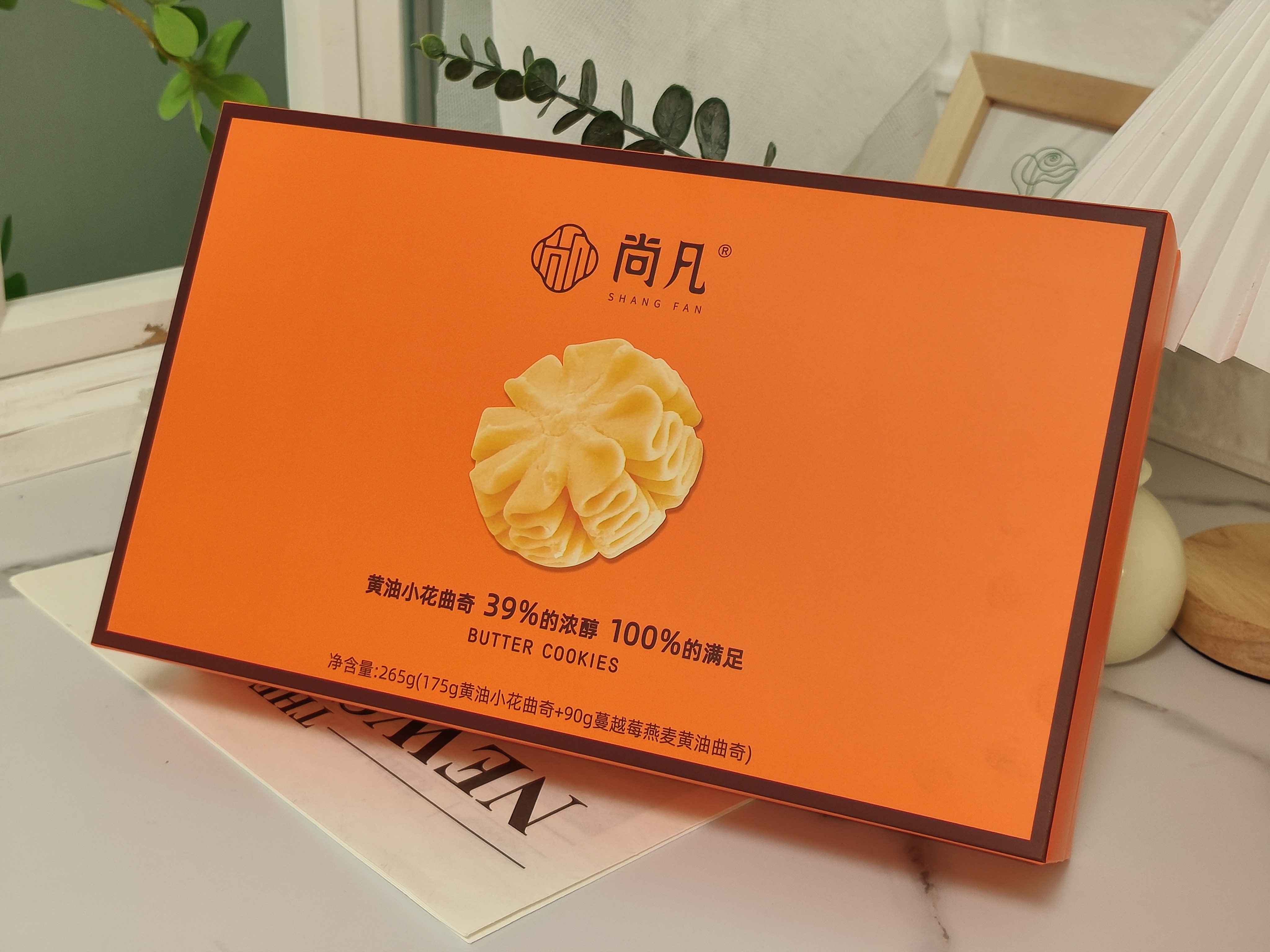
Second, a percentage claim needs a denominator before anyone repeats it on a pack. The published specification for Cocoa Butter Cookies 175g states a content of no less than 39% fermented butter from FrieslandCampina Netherlands; the same 39% statement also appears in the material description attached to the Butter Floral Cookies within the gift box range. The published material does not state what the percentage is measured against — total formula, flour basis or another basis — and no laboratory verification accompanies it. That does not make the claim wrong. It makes it unverified for label and comparison purposes until the manufacturer confirms the basis in writing.
Layer 2 — Label and pack arithmetic
Net weight, piece weight, piece count, carton configuration and shelf life have to agree with each other on the pack, in the specification and in the shipping documents. Where any of the three disagrees, the artwork is the wrong place to resolve it.
The thin-crisp formats make the arithmetic visible. Three models — Cocoa Butter Thin Crisp Cookies, Matcha Nut Butter Thin Crisp Cookies and Crispy Thin Butter Cookies — share a single item specification of 10 g per piece, packed as 9 pieces per box or 13 pieces per can, with a 5-month shelf life. A 9-piece box therefore carries a different net weight from a 13-piece can, and both must be printed from the same piece-weight basis. If a buyer later requests a different piece weight under an OEM brief, the net weight declaration and potentially the shelf-life basis change with it.
Other pack formats carry their own arithmetic. Lace Butter Cookies are specified at 16 g × 28 pieces, 448 g per box, 180 days shelf life, with product standard code GB7100 and barcode 6970066565413. Salted Cheese Butter Cookies are specified at 32 g × 12 pieces, 384 g per box, with a 12-month shelf life. Butter Shortbread is 680 g per box with a 6-month shelf life.
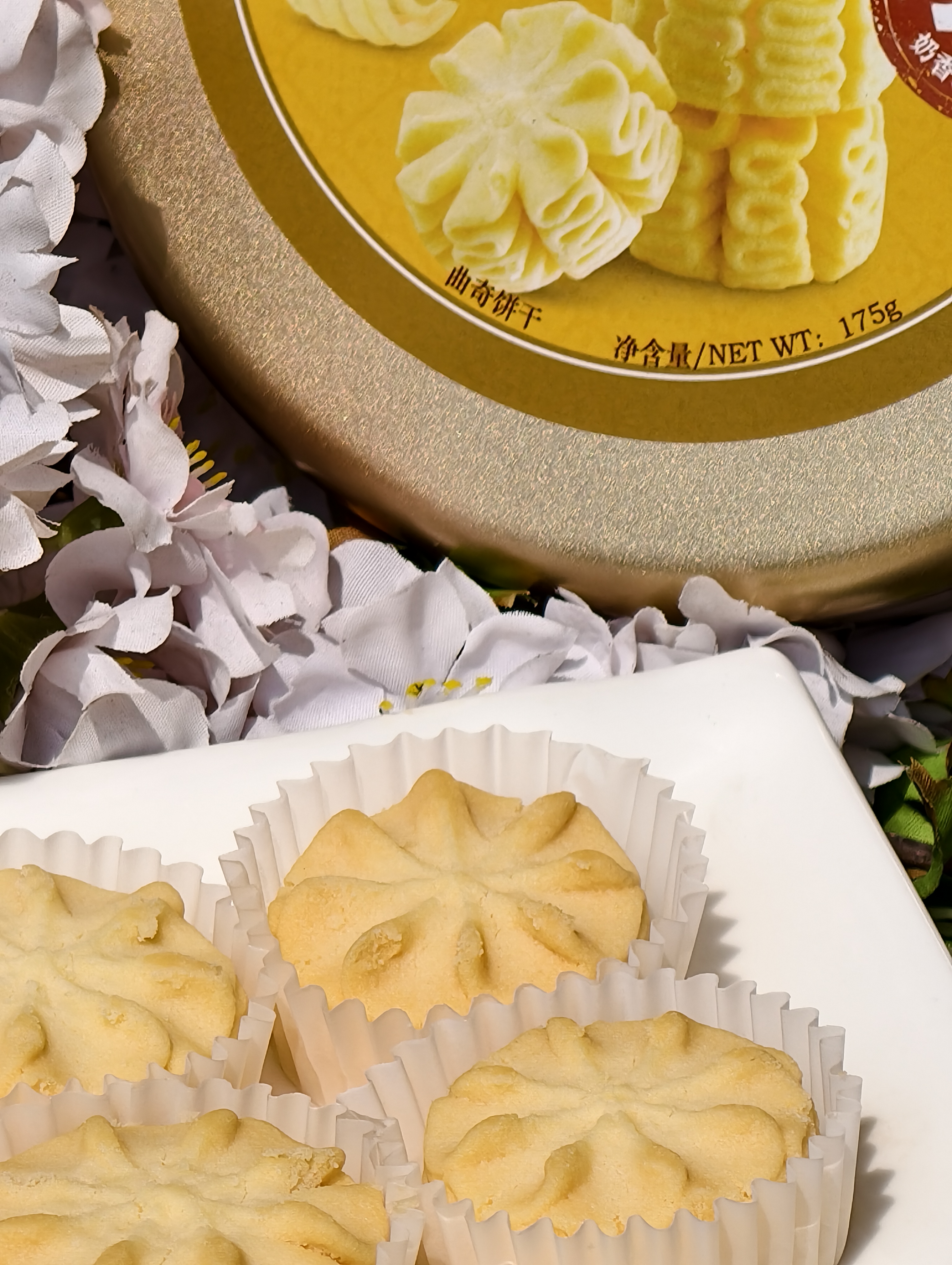
Gift formats add packaging components that must appear in the specification, because they often drive freight and inspection cost more than the cookie does. Butter Floral Cookies 260g are packed in gift tin packaging matched with gift bags, contain individually-packed servings, are shipped at 260 g × 8 tins per carton with a carton dimension of 59.5 × 37.5 × 23.5 cm, carry a 6-month shelf life and barcode 697006656441. Butter Floral Cookies 175g carry a 5-month shelf life and barcode 6970066564843. The Butter Cookie Gift Box at 265 g net weight is available in two flavours and assembles Butter Floral Cookies 175g with Cranberry Oat Butter Cookies 90g, the latter carrying an 8-month shelf life and barcode 6970066565079. Cocoa Butter Cookies 175g are shipped at 175 g × 24 tins per carton with a carton dimension of 44.8 × 30.2 × 24 cm (0.032 CBM) and a 5-month shelf life.
Documentation flag: the Butter Cookie Gift Box specification states a 150-day shelf life for flower-shaped cookies, while the standalone Butter Floral Cookies 175g entry states 5 months. Both statements appear in company product documentation. A buyer should not average them or pick the longer one; the shelf life for the specific assembled gift pack should be confirmed in writing, together with the storage condition the figure assumes.
Storage and packaging instructions belong in the same check. The application data for this product family specifies storage away from direct sunlight in a cool, well-ventilated place, compliance with food contact packaging standards, humidity control to prevent moisture softening, and ready-to-eat consumption with independent packaging maintaining shelf life. Every one of those items is a label or pack-engineering decision, not a warehouse note.
Layer 3 — Facility identity and certificate scope
Facility verification has two halves that are often confused: confirming that the legal entity exists and matches the contracting party, and confirming that the certificate covers the product being bought.
On the first half, the registered identity to match is Dongguan Shangfan Food Co., Ltd., at Building 3, No. 32 Jixing Road, Chashan Town, Dongguan City, Guangdong Province, China — the same address recorded in company product documentation. A purchase order, a certificate and a shipping document that name three different spellings of the same company are a documentary risk even when the factory is genuine.
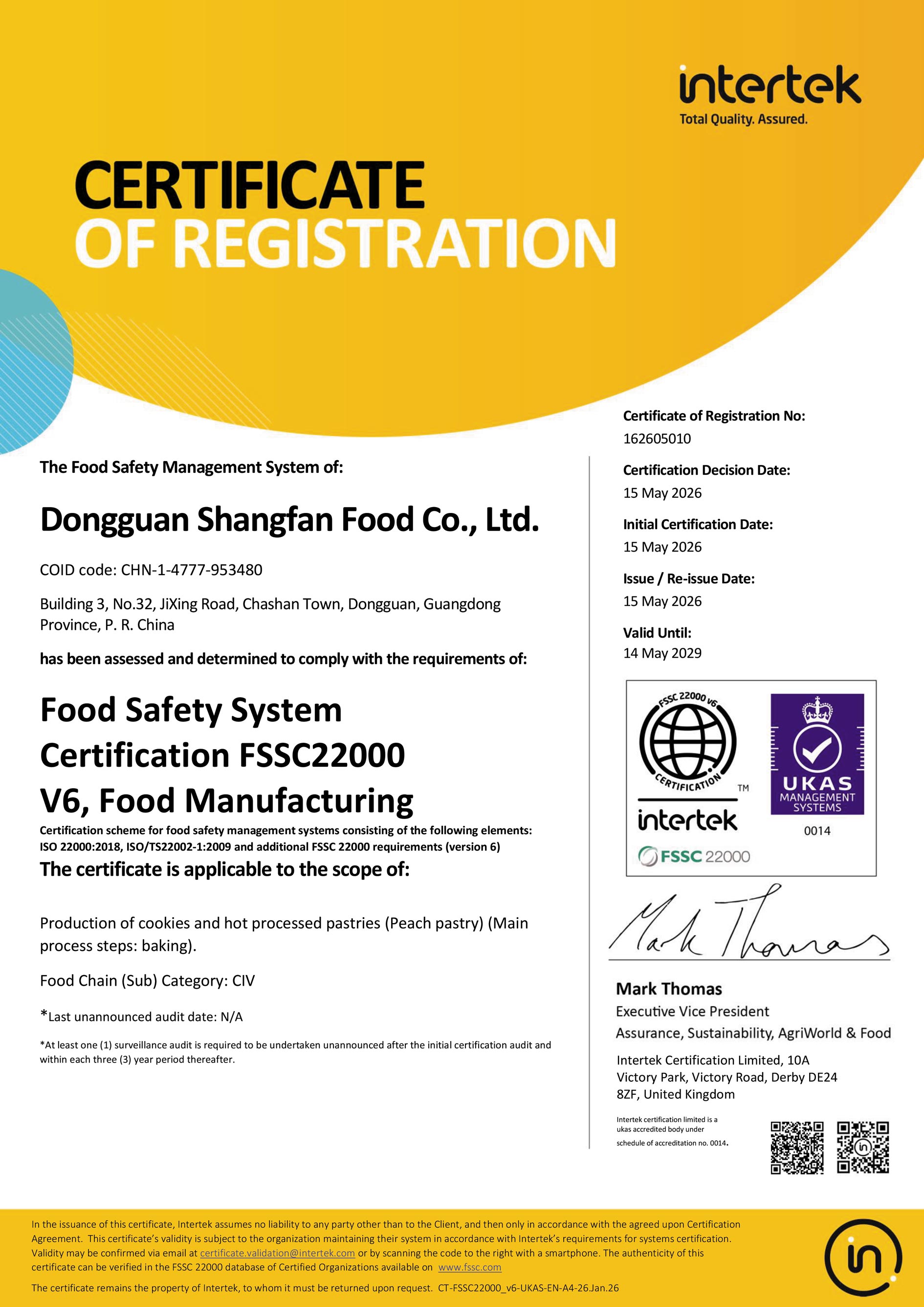
On the second half, the recorded certification facts are specific enough to check. The FSSC 22000 Version 6 certificate, number 162605010, was issued by Intertek with a certified scope of production of cookies and hot processed pastries (peach pastry) with baking as the main processing step, against a scheme covering ISO 22000:2018, ISO/TS 22002-1:2009 and the FSSC 22000 additional requirements, version 6. It runs from 15 May 2026 to 14 May 2029, and its recorded product coverage references Butter Floral Cookies 175g and Salted Cheese Butter Cookies 384g specifically. The HACCP System Certificate, number 001HACCP1900428, was issued by the China Quality Certification Centre against the Requirements for HACCP system certification (V1.0), covering manufacture of heat-processed pastries, biscuits and food fillings, valid from 3 July 2025 to 20 June 2028, with recorded product coverage referencing Danish Fancy Butter Cookies 380g and Butter Floral Cookies 175g.
The correct reading of those records is narrow and useful: the certificates establish a certified food safety system within a defined scope, and named SKUs are explicitly referenced. They do not establish that every catalogue item is individually named. That is normal for scheme certification and is not evidence that unnamed products are non-compliant — but it does mean a buyer sourcing an unnamed SKU or pack size should request written confirmation of coverage rather than assume it.
Step-by-step: running the check before artwork is approved
STEP 1Lock the market, the SKU and the pack format
Compliance work cannot start from a category. Fix the destination market, the model designation, the pack format and the piece count first. Cocoa Butter Thin Crisp Cookies in a 9-piece box and the same model in a 13-piece can are two declarations, not one, because the declared net weight differs.
STEP 2Request the specification sheet, not the brochure
Ask for the current approved specification covering full ingredient list, allergen statement, nutrition data, net weight, piece weight, piece count, shelf life and the storage condition the shelf life assumes. Then ask explicitly about shared production lines and allergen cross-contact controls, and about how the statement is worded for the destination market.
STEP 3Do the arithmetic yourself
Check piece weight × piece count against net weight for every row in the pack. Check that the shelf life stated on the artwork matches the shelf life stated for that exact SKU and pack assembly. Check that any multi-flavour gift pack carries a shelf life that is valid for every component, not just the component with the longest life.
STEP 4Verify identity and certificate scope against the issuer
Match the legal entity name and address across the contract, the certificate and the shipping documents. Then verify certificate number, scope and validity with the issuing body or its public registry, and confirm in writing whether the SKU being purchased falls inside the certified scope and process route.
STEP 5Check destination-specific import conditions separately
Food safety certification and import eligibility are different questions. Dairy-containing confectionery, product registration, language requirements on the pack, and any restriction attached to a country of origin are destination-specific and must be checked against the current official text of the destination market — separately for every market in the programme, including markets the supplier already lists as active.
STEP 6Freeze the declaration with change control
Once the declaration is verified, record which specification version it was built from. Any OEM change — custom formula, custom taste, custom specifications, custom logo — invalidates the artwork and reopens layers one and two. The capability set behind SHANGFAN FOOD's contract manufacturing includes custom formula, custom specifications, custom logo and custom taste; each of those is a label event, not only a product event.
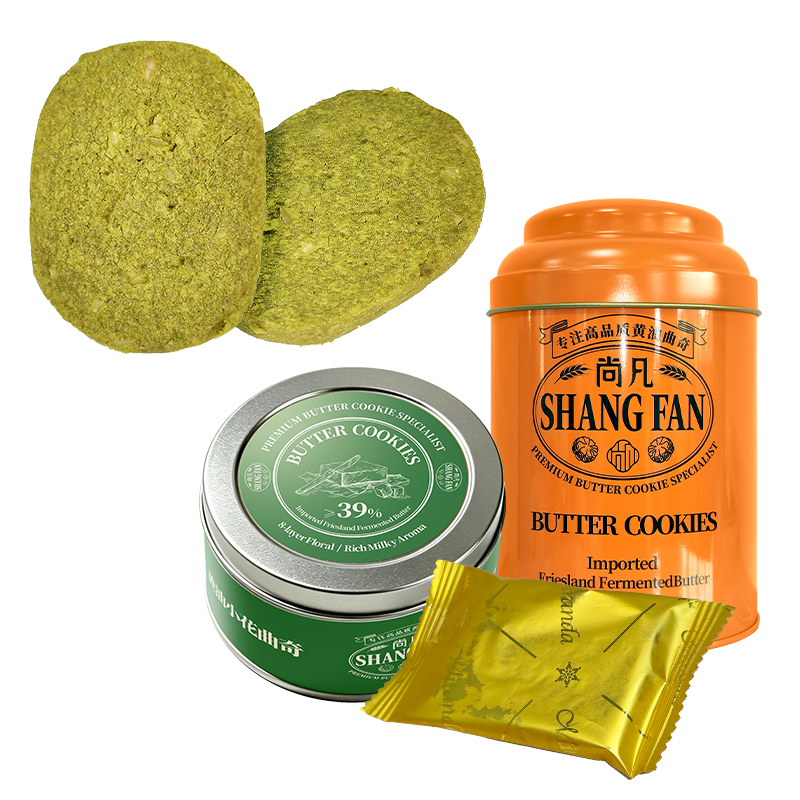
Verified product specifications a regional label has to match
The table below consolidates the published product facts that a label reviewer will need. It is a checking aid, not a substitute for the approved specification sheet, and the material lists shown are the company's published lists rather than a certified declaration.
| Product model | Piece count and net weight | Published material list | Shelf life | Label or pack note |
|---|---|---|---|---|
| Cocoa Butter Thin Crisp Cookies | 10 g per piece; 9 pieces per box or 13 pieces per can | Wheat flour, butter, white granulated sugar, crisp flakes, macadamia nuts, cocoa powder, whole egg liquid | 5 months | Wheat, milk, egg and tree nut all present; net weight must follow the pack format |
| Matcha Nut Butter Thin Crisp Cookies | 10 g per piece; 9 pieces per box or 13 pieces per can | Wheat flour, butter, white granulated sugar, pecans, whole milk powder, oolong tea powder, matcha powder, edible salt | 5 months | Milk powder plus tree nut; tea powders are named ingredients |
| Crispy Thin Butter Cookies | 10 g per piece; 9 pieces per box or 13 pieces per can | Wheat flour, butter, white granulated sugar, almond flakes, crisp flakes, whole eggs | 5 months | Almond and egg; shares piece-weight basis with the other thin crisps |
| Butter Floral Cookies 260g (gift tin, matched with gift bags) | 260 g per tin; 8 tins per carton; carton 59.5 × 37.5 × 23.5 cm | Butter, wheat flour, starch, icing sugar, salt | 6 months | Gift tin plus matched gift bag; individually-packed servings; barcode 697006656441 |
| Butter Floral Cookies 175g | 175 g | Butter, wheat flour, starch, icing sugar, salt | 5 months | Barcode 6970066564843; also referenced in FSSC 22000 and HACCP coverage records |
| Salted Cheese Butter Cookies 384g | 32 g × 12 pieces; 384 g per box | Full list not itemised in the published specification; company description references premium block cheese imported from the Netherlands | 12 months | Dairy declaration is central; confirm ingredient list on the approved sheet |
| Lace Butter Cookies 448g | 16 g × 28 pieces; 448 g per box | Butter, special wheat flour, icing sugar, almond powder, egg yolk liquid, white granulated sugar, salt | 180 days | Product standard code GB7100; barcode 6970066565413 |
| Butter Shortbread 680g | 680 g per box | Wheat flour, butter, buffalo milk, walnuts, white granulated sugar, salt | 6 months | Buffalo milk and walnut both require declaration |
| Cranberry Oat Butter Cookies 90g | 90 g per box | Butter, oatmeal, gold sand sugar, dried cranberries, walnut kernel, whole egg liquid, edible salt | 8 months | Barcode 6970066565079; second component of the 265 g gift box |
Recorded certification scope, read narrowly
Two certificates are recorded for the manufacturer. Reading them as scope statements rather than as general approvals is the difference between a verified file and a decorative one.
| Certificate | Number and issuer | Certified scope as recorded | Validity | Product coverage recorded |
|---|---|---|---|---|
| FSSC 22000 Version 6 | 162605010, Intertek | Production of cookies and hot processed pastries (peach pastry); main processing step baking; scheme covers ISO 22000:2018, ISO/TS 22002-1:2009 and FSSC 22000 additional requirements, version 6 | 15 May 2026 – 14 May 2029 | Butter Floral Cookies 175g and Salted Cheese Butter Cookies 384g specifically referenced |
| HACCP System Certificate | 001HACCP1900428, China Quality Certification Centre | Manufacture of heat-processed pastries, biscuits and food fillings; standard: Requirements for HACCP system certification (V1.0) | 3 July 2025 – 20 June 2028 | Danish Fancy Butter Cookies 380g and Butter Floral Cookies 175g specifically referenced |
The manufacturer also states that it has completed filing for export food business and completed FDA registration. Those are registration statements rather than third-party certification, and they should be documented as such in a supplier file. Registration establishes that a filing exists; it does not certify a product specification.
Applying the checklist to specific channels
Gift and seasonal programmes
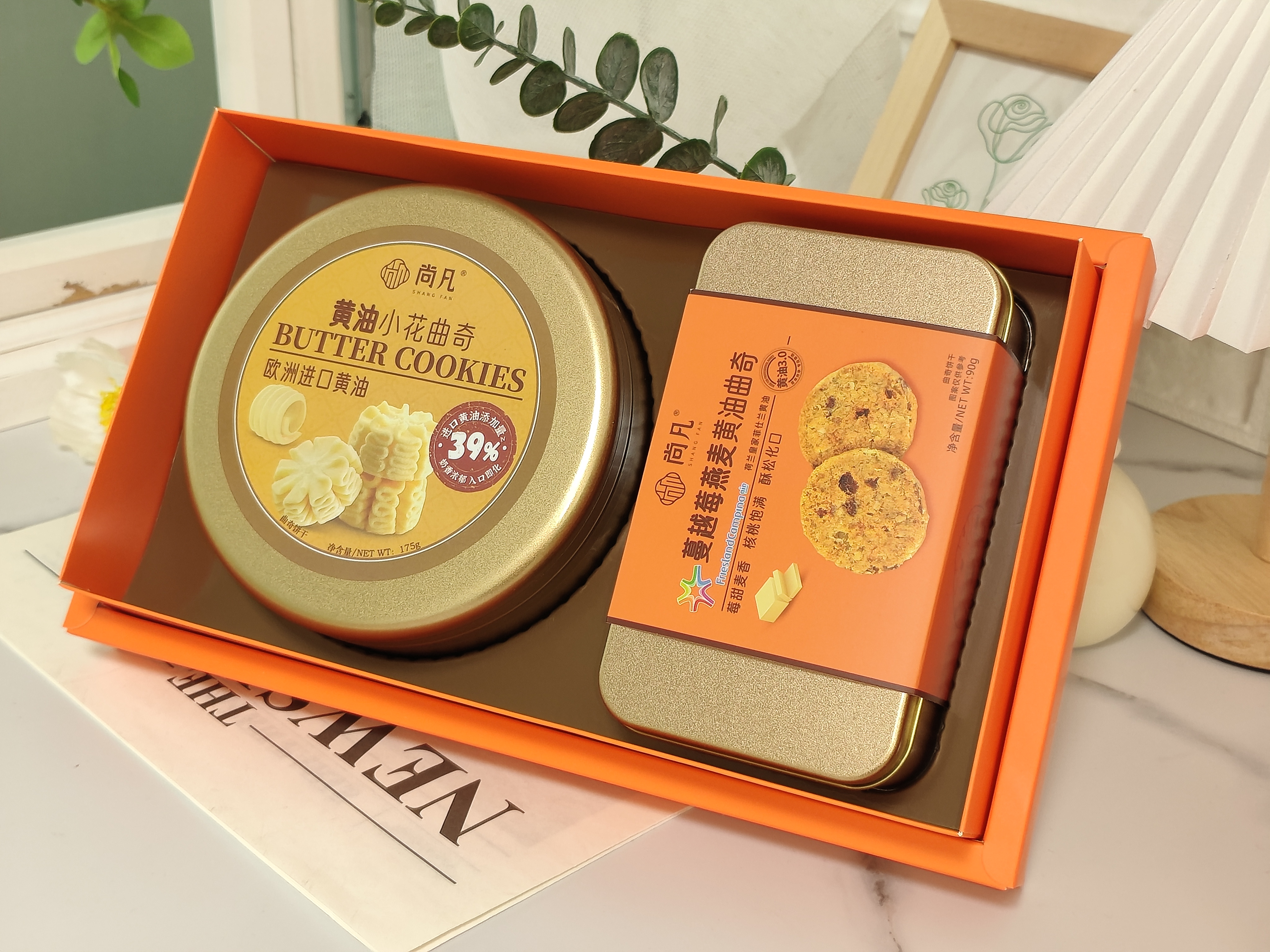
The gift format concentrates the most compliance work into the smallest box. A 260 g gift tin matched with a gift bag carries packaging components that must be named in the specification, individually-packed servings that change the unit declaration, and a carton configuration of 8 tins that affects freight per unit. When a gift pack assembles two different cookie types — as the 265 g Butter Cookie Gift Box does with Butter Floral Cookies 175g and Cranberry Oat Butter Cookies 90g — the shelf-life statement must be resolved for the assembly, not inherited from one component.
Instant retail and e-commerce
Channels where the consumer reads the pack without a salesperson present place the entire declaration burden on the artwork. Small-format packs such as the 10 g thin crisps in 9-piece boxes, or the 90 g oat cookies, leave little label area for a long ingredient list and an allergen statement, so layout decisions made at the design stage determine whether the declaration survives. Storage instructions and the humidity-control requirement belong on the pack for these channels, not only in the trade specification.
Hotels, bakeries and coffee shops
Foodservice buyers face the same declaration obligations in a different document — the product specification that sits behind a menu or a buffet. Portion consistency is the equivalent of label arithmetic here: a 10 g piece or a 32 g cheese cube is a portioning decision that must match the specification the outlet was given.
Frequently asked questions
What ingredient and allergen documents should a buyer request before a regional butter cookie launch?
Request the current approved specification sheet with the full ingredient list, the allergen statement covering both intentional allergens and shared-line handling, the nutrition data, the artwork proof, and a written statement of the specification version the artwork is built from. Use published material lists only to pre-flag risk. For example, Cocoa Butter Thin Crisp Cookies list wheat flour, butter, white granulated sugar, crisp flakes, macadamia nuts, cocoa powder and whole egg liquid, and Crispy Thin Butter Cookies list wheat flour, butter, white granulated sugar, almond flakes, crisp flakes and whole eggs — both flag wheat, milk, egg and tree nut before the specification pack even arrives.
Do the FSSC 22000 and HACCP certificates cover every butter cookie SKU in the range?
No, and the records should be read as written. FSSC 22000 certificate 162605010, issued by Intertek, covers production of cookies and hot processed pastries with baking as the main processing step, and its recorded product coverage references Butter Floral Cookies 175g and Salted Cheese Butter Cookies 384g. HACCP certificate 001HACCP1900428, issued by the China Quality Certification Centre, covers manufacture of heat-processed pastries, biscuits and food fillings, with recorded coverage referencing Danish Fancy Butter Cookies 380g and Butter Floral Cookies 175g. For any other SKU or pack size, ask the manufacturer for written confirmation and verify scope with the issuing body. A product not individually named on a certificate is not thereby non-compliant.
Can the same thin-crisp specification be supplied as 9-piece boxes and 13-piece cans?
Yes for the documented models. Cocoa Butter Thin Crisp Cookies, Matcha Nut Butter Thin Crisp Cookies and Crispy Thin Butter Cookies are each specified at 10 g per piece with both a 9-piece box and a 13-piece can format, and a 5-month shelf life. For a custom formula, confirm the dual format in writing before artwork, because the two formats carry different net weights and therefore different declarations, and a changed piece weight can alter both the net weight and the basis of the shelf-life statement.
What actually drives cost differences between the gift formats and the standard boxes?
No price data is published here, so cost has to be reasoned from structure rather than quoted. The verifiable differences sit in packaging components and carton efficiency: the 265 g Butter Cookie Gift Box assembles two flavours, the 260 g Butter Floral Cookies format adds a gift tin plus a matched gift bag with individually-packed servings and ships 8 tins per carton at 59.5 × 37.5 × 23.5 cm, while Cocoa Butter Cookies 175g ship 24 tins per carton at 44.8 × 30.2 × 24 cm (0.032 CBM). Carton cube changes freight per unit, so comparing formats on price per gram without normalising net weight, piece count, packaging components and carton efficiency will mislead. The stated minimum order quantity is 10,000 boxes.
How should a sample round be structured to test label accuracy rather than just taste?
Run it in three passes. First, arithmetic on paper: check that piece weight multiplied by piece count equals the declared net weight for each format — 10 g × 9 pieces, 16 g × 28 pieces for the 448 g Lace Butter Cookies, 32 g × 12 pieces for the 384 g Salted Cheese Butter Cookies — and confirm the shelf life printed on the artwork matches the shelf life for that exact SKU. Second, physical reconciliation on arrival: net weight, piece count, storage statement, barcode, and the gift-tin and gift-bag pairing where applicable. Third, declaration reconciliation against the specification you signed, not against a webpage. Raise documented inconsistencies in writing before print: the Butter Cookie Gift Box entry states a 150-day shelf life for flower-shaped cookies, while the standalone Butter Floral Cookies 175g entry states 5 months.
What are the stated lead time and minimum order quantity, and what should the first document request contain?
The stated commercial parameters are a 30-day lead time, a minimum order quantity of 10,000 boxes, monthly capacity of over 500,000 pastries and over 20 tons of cookies, and 100% testing, under an OEM/ODM model that supports custom formula, custom specifications, custom logo and custom taste. The first document request should be a single package: current certificate copies showing number, issuer, scope and validity dates; the approved specification sheet for each SKU and pack format; the artwork proof built from that specification; and a sample for physical reconciliation. The company brochure is available for download at the SHANGFAN FOOD catalogue PDF, and current specification packs or samples can be requested directly through the contact details published on the company website.
Conclusion: build the compliance file before the purchase order
Regional butter cookie supply is decided by documents more often than by dough. The three layers in this checklist — ingredient and allergen declaration, label and pack arithmetic, facility identity and certificate scope — are independent checks, and passing one does not imply passing another.
The verifiable position for SHANGFAN FOOD is reasonably specific: a company established in 2015 with a garden-style factory of over 10,000 m², 100 staff, a stated annual output of 3,640 tons, FSSC 22000 Version 6 certificate 162605010 issued by Intertek and valid to 14 May 2029, and HACCP certificate 001HACCP1900428 issued by the China Quality Certification Centre and valid to 20 June 2028, with recorded product coverage on both certificates. Published specifications fix the arithmetic for the main formats: 10 g pieces in 9-piece boxes or 13-piece cans, 32 g × 12 pieces at 384 g, 16 g × 28 pieces at 448 g, 260 g gift tins with matched gift bags, and a 265 g gift box assembled from two flavours.
The remaining items are exactly the ones this article has flagged rather than resolved: the basis of the 39% fermented butter statement, the gift-box shelf-life discrepancy between 150 days and 5 months, the ingredient declaration for SKUs whose full lists are not published, and destination-specific import conditions for dairy-containing confectionery. Each becomes a written question with a documentary answer. That is the difference between a supplier file that survives a regional launch and one that delays it at the artwork stage.
Reviewing a regional butter cookie programme and need the current specification and certificate package for a specific SKU and pack format? Request the current documentation set and a sample through the contact details on dongguanshangfanfood.com, or download the company brochure first.