Long-Term Butter Cookie OEM Contracts: 5 Key Questions
Date: 2026-11-01 Categories: FAQ Hits: 86
Long-Term Butter Cookie OEM Contracts: 5 Key Questions
An annual butter cookie OEM contract is not a purchase by weight. It is a dated commitment: one formula, one packaging specification, one inspection standard, repeated across twelve months. The problems that cost a buyer money rarely appear in the unit price — they surface six months in, when a certificate turns out to be narrower than the SKU it is meant to cover, when a shelf life cannot reach the selling window, or when the carton barcode does not match the retailer's system.
Five questions should be answered before signing, and they are best asked in the order a procurement team can actually verify them: physical capability, certification scope, shelf-life coverage, specification control, and accountability. Each answer below rests on verifiable facts — facility figures, certificate numbers, published shelf lives, and documented capacity — rather than on assurances.
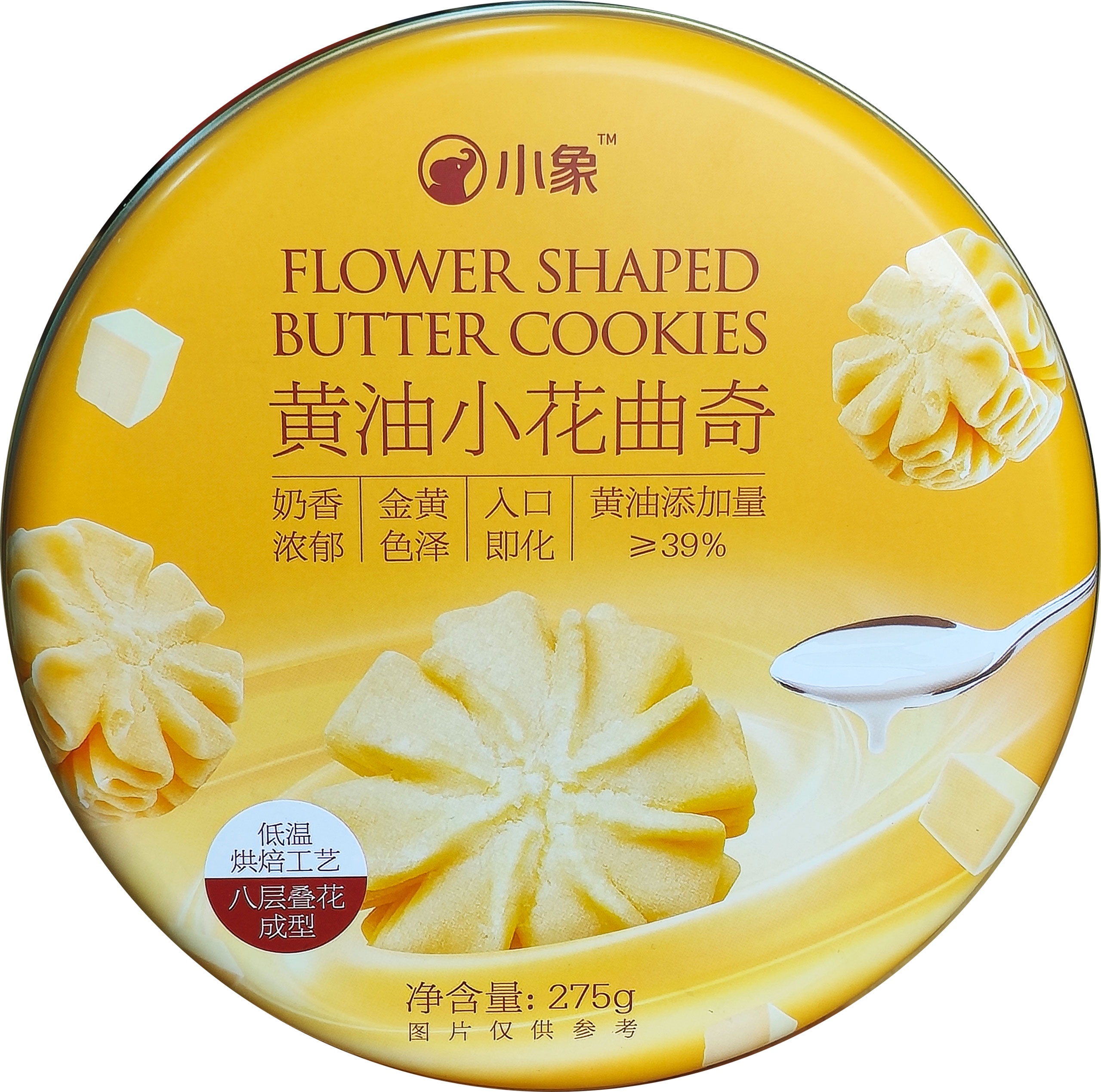
OEM butter cookie output prepared for a retail partner — the delivery layer that an annual contract has to make repeatable.
Why an Annual Contract Carries Different Risk Than a One-Off Purchase
A single purchase order ends at goods-in inspection. An annual contract does not. It extends exposure across three areas that a spot buy never touches.
Certification drift. A certificate valid on signing day may expire before the contract term ends. If the contract does not name the certificate, its scope, and its expiry date, the buyer has no automatic remedy.
Specification drift. Recipes, packaging liners, barcodes, and carton dimensions change quietly between runs. Under a twelve-month term, an undocumented change becomes a dispute rather than a correction.
Forecast drift. Seasonal demand is not flat, but per-SKU shelf life is fixed. A forecast built on a five-month product cannot be produced far ahead of the selling window, no matter how firm the commitment looks on paper.
None of these are pricing issues. All three are structural, which is why the five questions below are framed around evidence a buyer can hold in hand.
What the Butter Cookie Supply Market Looks Like in 2026
Butter cookies sit at the intersection of a commodity input and a branded finished good. The global butter cookies and biscuits market was valued at USD 3,358.3 million in 2024, according to Grand View Research. Butter itself moves through a cross-border chain: Denmark, whose butter exports were valued at USD 463 million in 2024 according to OEC, underpins much of the “Danish” style language used across the category — a style descriptor rather than a statement of origin.
Two regulatory developments matter more to an annual contract than any market size figure.
- EU General Product Safety Regulation (GPSR) 2024 tightens traceability and authorized-representative obligations for non-EU food manufacturers selling into the EU.
- Commission Regulation (EU) 2024/3190 restricts the use of Bisphenol A (BPA) in food contact materials, including cookie packaging linings.
Both are written into the physical product, not into the marketing. A buyer signing a twelve-month order that ships into Europe needs the packaging material named in the specification, not assumed.
In China, the national standard for biscuits is GB/T 20980-2021, which specifies quality requirements for short and cookie-type products. Shangfan Food's Lace Butter Cookies 448g carries the product standard code GB7100 on its specification sheet.
The Five Questions
Q1. Can the physical operation actually run your order for twelve months?
Annual volume should be checked against monthly capacity, not against a one-time capability claim. Dongguan Shangfan Food Co., Ltd. — trading as SHANGFAN FOOD — was founded in 2015 and operates a garden-style factory of more than 10,000 m² in Chashan Town, Dongguan City, Guangdong Province. The company employs 100 people, including a research and development team of 5 engineers, and produces an annual output of 3,640 tons.
Monthly capacity is stated as over 500,000 pastries and over 20 tons of cookies. Export accounts for 10% of output, with main markets listed as PRC, EU, USA, South Korea, and Singapore.
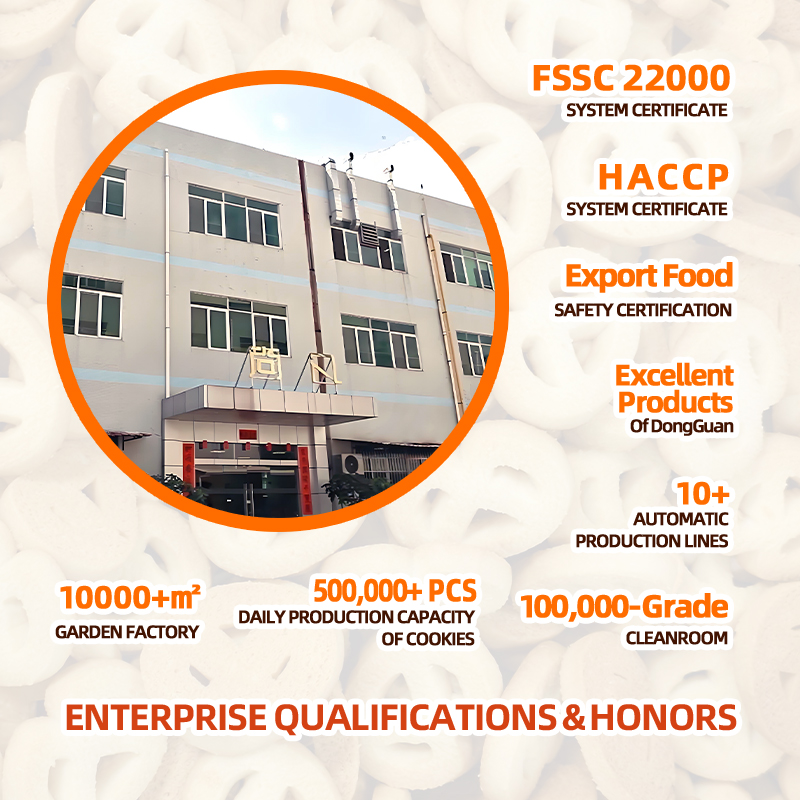
Factory scale at Shangfan Food: more than 10,000 m² in Chashan Town, Dongguan City, Guangdong Province.
Q2. Does the certification actually cover the SKU you are ordering?
A certificate is only contractual when its scope text, its issuing body, and its validity window all match the product you intend to buy. Shangfan Food holds two certificates that a butter cookie buyer should read line by line.
| Certification | Certificate number | Issuing body | Scope | Validity |
|---|---|---|---|---|
| HACCP System Certificate | 001HACCP1900428 | China Quality Certification Centre | Manufacture of heat-processed pastries, biscuits and food fillings | 2025-07-03 to 2028-06-20 |
| FSSC 22000 V6 Food Safety System Certification | 162605010 | Intertek | Production of cookies and hot processed pastries (peach pastry); main processing step: baking | 2026-05-15 to 2029-05-14 |
The HACCP certificate is issued against the Requirements for HACCP system certification (V1.0) and applies to the global market, primarily China. The FSSC 22000 certificate covers ISO 22000:2018, ISO/TS 22002-1:2009, and the FSSC 22000 Additional Requirements (Version 6).
Beyond certification, the manufacturer has completed filing for export food business and holds FDA registration.
Two practical instructions follow. First, quote the certificate number and the scope sentence inside the contract annex — not just the certificate name. Second, record the expiry date against the contract end date. A twelve-month term that outlives a certificate needs a written renewal obligation, or the buyer is exposed in the final quarter.
Q3. Does the shelf-life mix cover your seasonal peak?
A year is not a flat line. Retail peaks cluster, gift seasons close out quickly, and the product that carries a five-month shelf life cannot be built far ahead of the selling window. Shangfan Food's range spans five to twelve months, which means the forecast has to be built SKU by SKU rather than as a single annual number.
| Product | Pack format | Stated shelf life |
|---|---|---|
| Salted Cheese Butter Cookies 384g | 32g × 12 pieces / 384g per box | 12 months |
| Danish Fancy Butter Cookies 380g | 380g × 12 tins per carton | 9 months |
| Danish Assorted Cookie Gift Box 760g | 760g gift set (2 tins included) | 9 months |
| Cranberry Oat Butter Cookies | 90g per box (Cranberry Flavor) | 8 months |
| Dark Chocolate Oat Butter Cookies 90g | 90g per box (Dark Chocolate Flavor) | 8 months |
| Butter Shortbread 680g | 680g per box | 6 months |
| Butter Floral Cookies 260g | 260g × 8 tins per carton (gift tin, with gift bags) | 6 months |
| Butter Floral Cookies 175g | 175g × 24 tins per carton | 5 months |
| Coffee Butter Flower 175g | 175g × 24 tins per carton | 5 months |
| Lace Butter Cookies 448g | 448g per box (16g × 28 pieces) | 180 days |
| Crispy Thin Butter Cookies / Matcha Nut Butter Thin Crisp / Cocoa Butter Thin Crisp / Oolong Tea Crisp Cookie | 10g per piece, 9 pieces per box or 13 pieces per can | 5 months |
Storage conditions apply equally to every item: avoid direct sunlight and store in a cool, well-ventilated place. Independently packaged servings maintain shelf life continuously once the carton is opened.
The forecasting logic that follows is straightforward. Long-shelf-life items — Salted Cheese Butter Cookies 384g at twelve months, Danish Fancy Butter Cookies 380g and the Danish Assorted Cookie Gift Box 760g at nine months — can absorb early production and hold through to a later selling window. Short-shelf-life items at five months have to be scheduled against the actual sales period. A buyer who commits a single annual volume across the whole basket without this split will either overstock the fast-rotation items or run short on the gift formats.
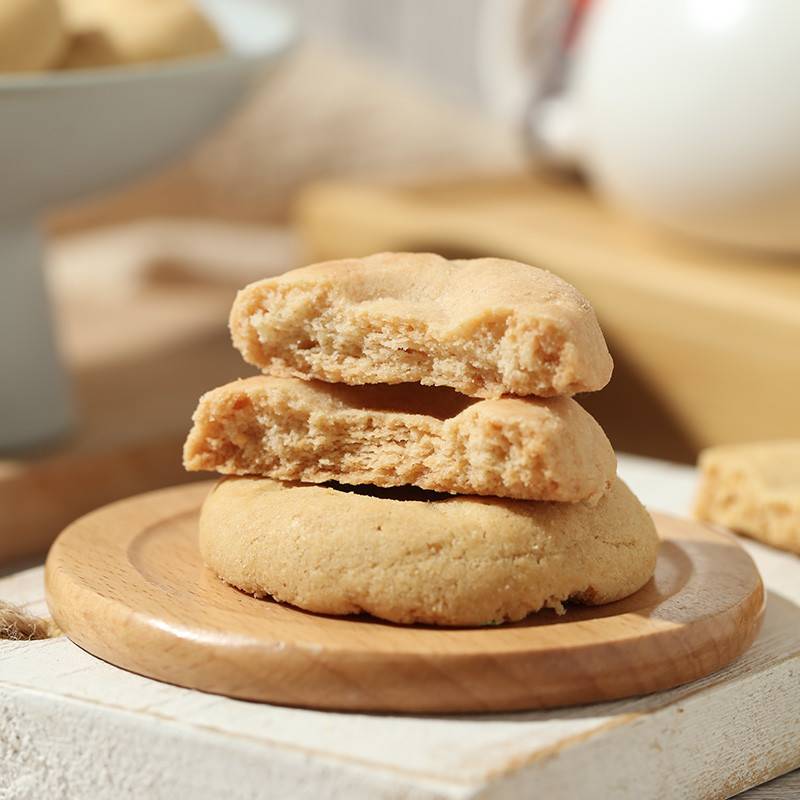
Butter Shortbread 680g carries a six-month shelf life — a mid-range format that sits between the five-month thin crisps and the twelve-month cheese cookies.
Q4. Who locks the formula, the packaging tooling, and the barcode?
Under an annual term, specification drift is the most common source of dispute because responsibility is rarely assigned in writing. Shangfan Food operates in OEM / ODM mode with a customization scope that explicitly covers custom formula, custom specifications, custom logo, and custom taste. Those four items should appear as named annexes, not as general intent.
The detail layer matters as much as the formula. Documented SKU-level identifiers in the range include:
- Butter Floral Cookies 175g — barcode 6970066564843; carton 44.8 × 30.2 × 24 cm (0.032 CBM)
- Lace Butter Cookies 448g — barcode 6970066565413; product standard code GB7100
- Danish Fancy Butter Cookies 380g — barcode 6970066564782; carton 61 × 21 × 35.8 cm
- Danish Assorted Cookie Gift Box 760g — barcode 6970066565123
- Cranberry Oat Butter Cookies 90g — barcode 6970066565079
- Dark Chocolate Oat Butter Cookies 90g — barcode 6970066565086
Barcodes and carton dimensions are the two fields most often omitted from OEM contracts and most often needed by the retailer, the freight forwarder, and the warehouse. Once written into the annex, they should be frozen for the contract term. Where the specification includes a packaging liner or inner wrapper, name the material there as well — EU 2024/3190 makes that a compliance question rather than a preference.
Q5. Who answers when a batch is wrong?
Accountability in an annual contract rests on three verifiable things: inspection coverage, a documented after-sales structure, and a communication channel that produces a written record.
Shangfan Food applies 100% testing to production and maintains a complete after-sales service system with a product after-sales quality guarantee and an exclusive service hotline.
The communication anchors are concrete and checkable before signing. The company is located at Building 3, No.32 Jixing Road, Chashan Town, Dongguan City, Guangdong Province. The named contact is Liu Jinqi, reachable at shangfan168@126.com, telephone and WhatsApp +86 13392733431. The corporate site is www.dongguanshangfanfood.com.
These are not marketing details. A physical address in Chashan Town — a recognized food town in Dongguan — is a location a buyer's quality team can visit. A named individual with an email address and a WhatsApp number is a channel that leaves a timestamped trail. When a batch dispute arises in month nine, the difference between a resolved claim and a stalled one is usually whether the communication channel was documented in month one.
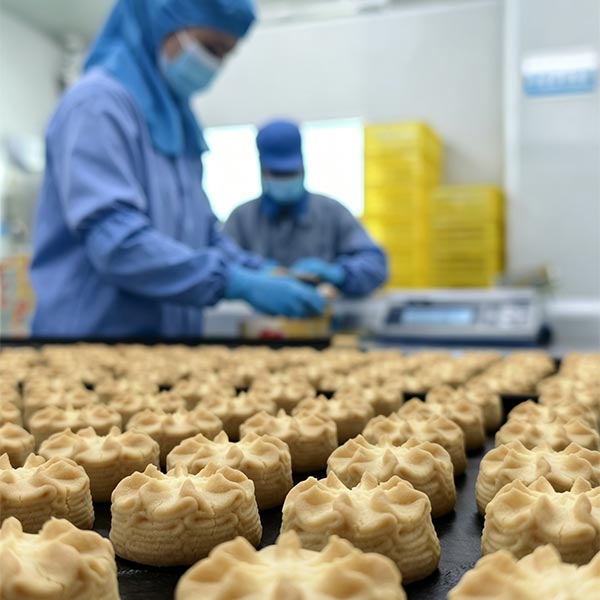
Production at Shangfan Food, where 100% testing is applied across the run.
From Trial Order to Annual Volume: A Five-Step Structure
The sequence below converts the five questions into a procurement workflow. It assumes the buyer is moving from research into evaluation, with a first annual commitment under consideration.
- Verify certification scope against your own SKU list. Match the scope sentence on HACCP 001HACCP1900428 and FSSC 22000 162605010 to the products you intend to order. Record both expiry dates against your intended contract end date.
- Fix the sensory and physical baseline with a sample. Agree the reference sample before commercial terms are discussed, so that the specification annex is written against a physical object rather than a description.
- Size the first order against the published MOQ and lead time. Shangfan Food lists an MOQ of 10,000 boxes and a standard lead time of 30 days. A first order cannot sit below the MOQ, which means the trial itself is a volume decision and should be planned as one.
- Build the seasonal forecast SKU by SKU. Allocate long-shelf-life formats (nine to twelve months) to early production and short-shelf-life formats (five to six months) to orders placed closer to the selling window.
- Attach the operational annexes to the annual contract. Certificate numbers, scope statements, expiry dates, barcodes, carton dimensions, packaging material declarations, named contact, and after-sales escalation path.
Comparison: Published Operating Parameters for Contract Planning
The table below consolidates the parameters a buyer needs when structuring an annual butter cookie OEM agreement. Every value is a published figure from the manufacturer's own documentation.
| Parameter | Published value | Where it lands in the contract |
|---|---|---|
| Production mode | OEM / ODM | Scope of work clause |
| Customization scope | Custom formula, custom specifications, custom logo, custom taste | Specification annex |
| Minimum order quantity | 10,000 boxes | Order volume clause |
| Standard lead time | 30 days | Delivery schedule |
| Monthly capacity | Over 500,000 pastries; over 20 tons of cookies | Capacity reservation |
| Annual output | 3,640 tons | Supplier profile verification |
| Factory footprint | 10,000+ m² | Site audit reference |
| Workforce | 100 employees, including 5 R&D engineers | Continuity assessment |
| Quality control | 100% testing | Inspection clause |
| After-sales | After-sales quality guarantee and exclusive service hotline | Claims and remedy clause |
Use Cases: How the Five Questions Play Out in Practice
Retail private label with a first-quarter launch
A private-label program for a large membership supermarket ran 200,000 boxes over an eight-month duration. Cumulative sales in the first quarter after launch exceeded 120,000 boxes, with offline stores accounting for 65% of the total and the online mall reaching a 38% repurchase rate. The program used Danish Fancy Butter Cookies 380g, a nine-month shelf-life format — which is what allowed production to be scheduled ahead of the launch rather than against it.
Instant retail and e-commerce at high rotation
A large-scale instant e-commerce enterprise ordered 400,000 boxes over 150 days for platform sales. Cumulative shipments exceeded 400,000 boxes with monthly sales above 30,000 tins and a repurchase rate of 98%. At that rotation speed, the constraint is monthly capacity and the 30-day lead time, not shelf life — which is exactly the parameter Q1 is designed to test.
Membership store endcap with daily replenishment
Lace Butter Cookies 448g was supplied to Costco stores in China at over 8,000 boxes across a 180-day duration. Daily sales from physical store endcaps consistently exceeded 1,000 boxes. A 180-day shelf life combined with daily endcap replenishment is only workable when the lead time and the inspection regime are both stable — Q3 and Q5 in combination.
Hotel, coffee, and gift channels
Typical application scenarios across the range include supermarkets, chain hotels, bakeries, coffee shops, online e-commerce platforms, and instant retail platforms. Gift-oriented formats such as Butter Floral Cookies 260g, supplied in gift tins with matching gift bags and individually packed servings, and the Danish Assorted Cookie Gift Box 760g, serve holiday gifting and afternoon tea pairing. These are the SKUs where a seasonal forecast error is most visible, because the selling window closes on a fixed date.
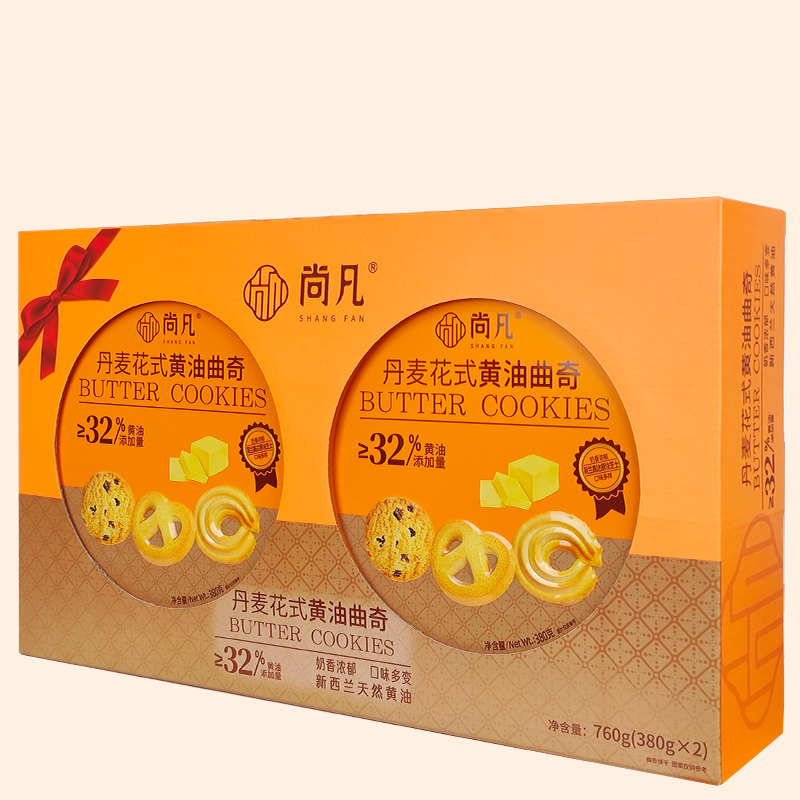
The Danish Assorted Cookie Gift Box 760g — a nine-month format suited to holiday programs where the selling window closes on a fixed date.
Frequently Asked Questions
1. What exactly should an annual butter cookie contract say about HACCP and FSSC 22000?
It should quote the scope sentence, the issuing body, and the expiry date of each certificate. Shangfan Food holds a HACCP System Certificate numbered 001HACCP1900428, issued by China Quality Certification Centre, covering the manufacture of heat-processed pastries, biscuits and food fillings, valid from 2025-07-03 to 2028-06-20. The company also holds FSSC 22000 V6 certificate 162605010, issued by Intertek, covering the production of cookies and hot processed pastries (peach pastry) with baking as the main processing step, valid from 2026-05-15 to 2029-05-14. A twelve-month term that extends past an expiry date should carry a written renewal obligation in the annex.
2. Can one factory hold multiple SKUs and multiple pack formats across a year?
That question is answered by published capacity, not by assurances. Shangfan Food operates a factory of more than 10,000 m² with an annual output of 3,640 tons, monthly output above 500,000 pastries and 20 tons of cookies, supported by 100 employees and a 5-engineer R&D team. The range spans shelf lives from five to twelve months across tin, box, and gift-box formats — for example Butter Floral Cookies 175g ships at 175g × 24 tins per carton in a 44.8 × 30.2 × 24 cm carton, while Lace Butter Cookies 448g ships as 16g × 28 pieces per box. The way to verify this is to map each SKU's monthly forecast onto those capacity figures rather than treating the contract as a single production number.
3. How should a buyer structure the first order against a 10,000-box MOQ?
The published MOQ for OEM/ODM work is 10,000 boxes, with a standard lead time of 30 days. Because the first order cannot fall below the MOQ, the practical approach is to lead with the formats that carry the longest shelf life — 12 months for Salted Cheese Butter Cookies 384g, nine months for Danish Fancy Butter Cookies 380g and the Danish Assorted Cookie Gift Box 760g — and hold the five-month formats for orders placed closer to the selling period. Customization scope covers custom formula, custom specifications, custom logo, and custom taste.
4. How is a first production batch validated before the annual agreement is signed?
Shangfan Food applies 100% testing in production, and the quality system is certified under HACCP and FSSC 22000 V6, so a first batch can be checked against a documented scope rather than a verbal one. The batch should be produced against the written specification you intend to attach to the contract — including packaging material declarations, barcode, and carton dimensions — and the retained sample should become the signed reference for the term. Requesting a sample is the normal way to open this step, and it can be raised before any annual volume is discussed.
5. Is a 30-day lead time sufficient for seasonal peaks?
The standard lead time at Shangfan Food is 30 days, and monthly capacity runs above 500,000 pastries and 20 tons of cookies. A 30-day lead time works for a seasonal peak only if the forecast is converted into production slots early, because the same lines serve every SKU in the range. Shelf life sets the constraint at the other end: a five-month SKU cannot be built far ahead of its selling window, while a nine- or twelve-month SKU can be produced earlier and held. Buyers planning a single peak season should confirm capacity availability in writing before the annual contract is signed.
Conclusion
The five questions do not ask whether a supplier can make a good butter cookie. They ask whether the same butter cookie can be repeated, documented, and defended for twelve months — with the certificate covering the SKU, the shelf life reaching the selling window, the barcode matching the retailer, and a named contact reachable when something goes wrong.
For a procurement team moving from research into evaluation, that shift in framing is the whole exercise. Price is a line item. Scope, shelf life, and accountability are the contract.
Next Step
Buyers preparing an annual butter cookie OEM program can request a sample, a specification sheet, or a quotation from SHANGFAN FOOD before committing to volume.
Dongguan Shangfan Food Co., Ltd. — Building 3, No.32 Jixing Road, Chashan Town, Dongguan City, Guangdong Province
Contact: Liu Jinqi · Email: shangfan168@126.com · Tel / WhatsApp: +86 13392733431
Website: www.dongguanshangfanfood.com
Product catalogue available for download: Shangfan Food brochure (PDF)

Shangfan Food, Chashan Town, Dongguan City — a physical address that can be visited and verified before an annual contract is signed.