Vetting a Butter Cookie Supplier: Factory Capability and Delivery Acceptance
Date: 2026-11-25 Categories: FAQ Hits: 596
Vetting a Butter Cookie Supplier: Factory Capability and Delivery Acceptance
Vetting a butter cookie supplier is two decisions, not one. The first is whether the factory can actually produce your specification at your volume. The second is whether the delivery that arrives can be formally passed or rejected against criteria both parties signed before production started.
Dongguan Shangfan Food Co., Ltd., which presents itself under the brand SHANGFAN FOOD, is a butter-cookie manufacturer established in 2015 and based in Chashan Town, Dongguan City, Guangdong Province, China. Its published profile — a 10,000+ m² garden-style factory, 100 employees, 3,640 tons of annual output, FSSC 22000 and HACCP certification, and OEM/ODM production — serves here as a concrete reference for what checkable supplier evidence looks like, and for the point at which that evidence stops short of a delivery guarantee.

Why vetting usually breaks at the acceptance stage, not the factory gate
Capability evidence is static: photographs, certificates, a sample box, a factory visit. Delivery is a time-bound commitment with money attached. The mismatch between the two is where most sourcing disputes begin.
Three structural gaps explain it:
- Capability claim versus capacity commitment. A factory can be entirely capable of making a thin crisp cookie and still have no allocated line time in your shipping window.
- Specification versus acceptance criteria. A spec sheet describes the product. Acceptance requires a sampling plan, defect classes, tolerances, a named inspector, a place and moment of inspection, and a remedy if the lot fails.
- Certificate presence versus certificate scope. A food-safety certificate may cover a process category or product family that does not include your SKU, or may have lapsed since the copy in your file was issued.
The practical consequence is that "off-spec" becomes unarbitrable. The buyer believes a texture, weight or pack appearance was promised; the supplier believes the delivered lot is within normal commercial variation. Neither side is lying; the contract simply never converted a claim into a test.
The working rule for the rest of this guide: every capability claim should be paired with one document and one contract clause. If a claim cannot produce either, it is marketing, not evidence.
What trade data and procurement specifications actually add
Category-level trade figures set the commercial backdrop but say nothing about an individual factory. World exports of sweet biscuits under HS 1905.31 reached USD 12.3 billion and 3.43 million metric tons in 2024, according to UN Comtrade-derived figures compiled by FreightAmigo. That is a broad sweet-biscuit category, not butter cookies specifically, so it indicates market scale rather than a butter-cookie demand forecast.
Procurement specifications are more useful, because they show what a written conformance standard looks like when it has to be enforced. The U.S. Defense Logistics Agency Commercial Item Description for cookies specifies, for Style C butter cookies, a distinct sweet butter flavor, light tan color, dense texture and varied shape; it requires processing under current good manufacturing practice and hazard-analysis-based preventive controls, referencing 21 CFR Part 117; and it requires the butter used to be U.S. Grade A or better. These requirements apply within that U.S. procurement context and are not a universal butter-cookie standard, nor are they claims about any supplier.
What they demonstrate is a structure: conformance can be built in layers — a sensory definition, an ingredient-grade requirement and a manufacturing-control requirement. A buyer's acceptance sheet should have the same three layers rather than a single line reading "as per approved sample."
Destination requirements sit on top of that. The supplied source set includes the UK government's Importing confectionery guidance, whose search summary flags possible restrictions concerning dairy-containing products from China. That indication must be verified against the current official rule for the specific product, composition and destination before any shipment is planned; it is not a conclusion about eligibility.
The two-gate framework in practice
Gate one ends in a capability evidence file. Gate two ends in a signed acceptance schedule attached to the purchase order. Both are produced before the first production run, and both are revisited at every reorder.
The four documents that carry the framework:
- Capability file — legal identity, site address, certificate numbers with scope and validity, process flow, ingredient specifications, product range.
- Acceptance criteria sheet — the attributes that define a conforming lot, with tolerances and test methods.
- Inspection plan — sampling size, defect classification, inspection point, inspector, documentation, and the cost bearer.
- Remedy schedule — notice window, replacement or credit mechanism, cost allocation, escalation contact.
Gate one — verifying factory capability with checkable evidence
Gate one is not a factory tour. It is a document review that a tour can confirm. The six checks below run in order, because a failure at any earlier check makes the later ones irrelevant.
Legal identity and site
The name on the contract, the name on the certificates and the name on the business licence must be the same legal entity, and the production site must match the address on the certificate. Shangfan's supplied data gives a single address — Building 3, No. 32 Jixing Road, Chashan Town, Dongguan City, Guangdong Province, China — which is what a buyer wants: one name, one site, no third-party subcontracting hidden in the chain. Request the business licence, the export food business filing record and the FDA registration entry, then compare the addresses character by character. A mismatch is a stop item, not a clarification.
Certification scope, not certificate presence
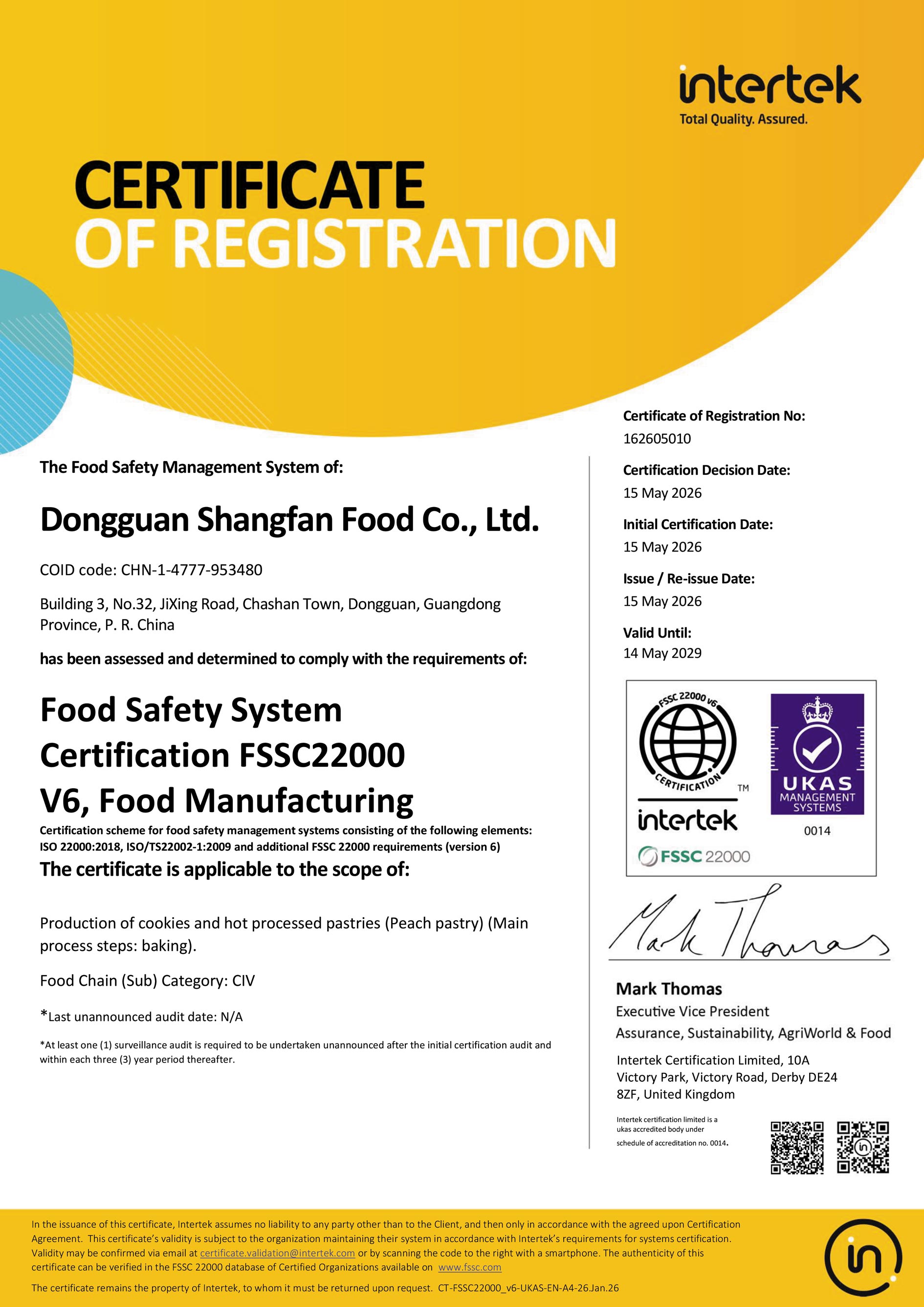
Read the number, the issuer, the scope wording and both dates. Shangfan's HACCP System Certificate carries number 001HACCP1900428, issued by CHINA QUALITY CERTIFICATION CENTRE on 3 July 2025 and valid to 20 June 2028, with a scope covering manufacture of heat-processed pastries, biscuits and food fillings, certified against the Requirements for HACCP system certification (V1.0). Its FSSC 22000 V6 certificate carries number 162605010, issued by Intertek on 15 May 2026 and valid to 14 May 2029, with a scope covering production of cookies and hot-processed pastries, main processing step baking, against ISO 22000:2018, ISO/TS 22002-1:2009 and the FSSC 22000 Additional Requirements (Version 6).
Two habits follow. First, confirm status with the issuing body's registry rather than trusting a scanned PDF, because a certificate can be withdrawn between audits. Second, note that FDA registration is a facility registration, not a certification of product conformity; the Shangfan profile describes it as completed filing alongside the export food business filing, which is the correct way to read it.
Converting capacity claims into throughput you can test
Scale figures are only useful once you know what they measure. Shangfan reports 3,640 tons of annual output, a monthly capacity of over 500,000 pastries and over 20 tons of cookies, 100 employees, a 10,000+ m² factory and a five-engineer R&D team. Those numbers come from separate data fields, and the basis of each — per line, per product family, per calendar month, gross or net of waste — is not stated in the supplied material. A buyer should therefore not divide one by the other to derive a utilisation rate; that calculation would be an invention, not an analysis.
What you can do is ask the supplier to state the basis of each figure in writing, then test the answer with a pilot order sized to your real shipment window. The output figure that matters is never the annual total; it is the tonnage or box count the supplier will commit to in your month.
Process controls and the "100% test" statement
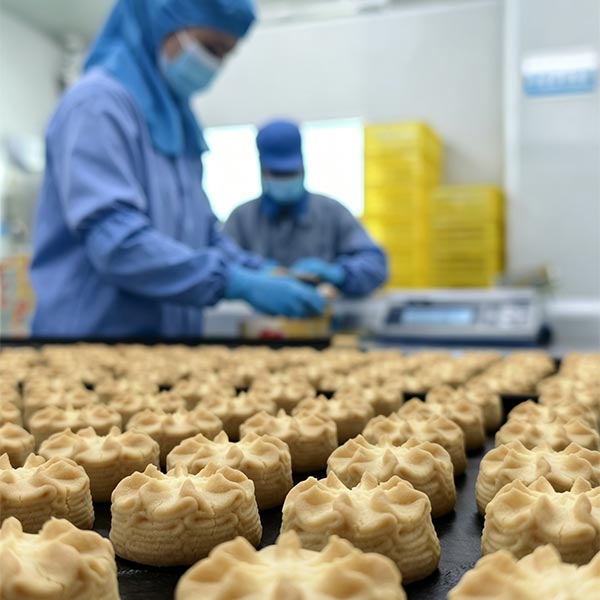
Shangfan's quality-control data states 100% test. Before that phrase enters a contract, establish what it covers. A general butter-cookie process runs through separate ingredient weighing, staged mixing, forming, baking and cooling, as described in the American Society of Baking's technical overview; each stage hosts different control points, and "100% test" could refer to unit weight, metal detection, seal integrity or visual grading — or to all of them at different rates.
Ask for the process flow diagram, the identified control points, the attribute tested at each, the record format and the retention period. A supplier that cannot produce a control plan on request is unlikely to produce batch records on a disputed delivery.
Formulation, ingredient and pack documentation
Formulation claims need a denominator. Shangfan's company product page for Cocoa Butter Cookies (175g) reports that the product contains no less than 39% fermented butter from FrieslandCampina Netherlands, but the supplied material does not state what the percentage is measured against — total formula, flour basis or another denominator — and no laboratory verification accompanies it. The honest move for a buyer is to request the ingredient specification and the certificate of analysis, and to refuse to rank suppliers on butter percentage until every quoted figure uses the same basis.
Pack data deserves the same treatment. The supplied product page reports a 265 g net weight for one butter-cookie gift box and a 150-day shelf life for flower-shaped cookies, without stating storage conditions or the validation method behind the shelf-life figure. Those are two separate facts about two separate things; merging them into "the 265 g box lasts 150 days" would be a documentation error that surfaces later as a rejected container.
Product-range fit by format
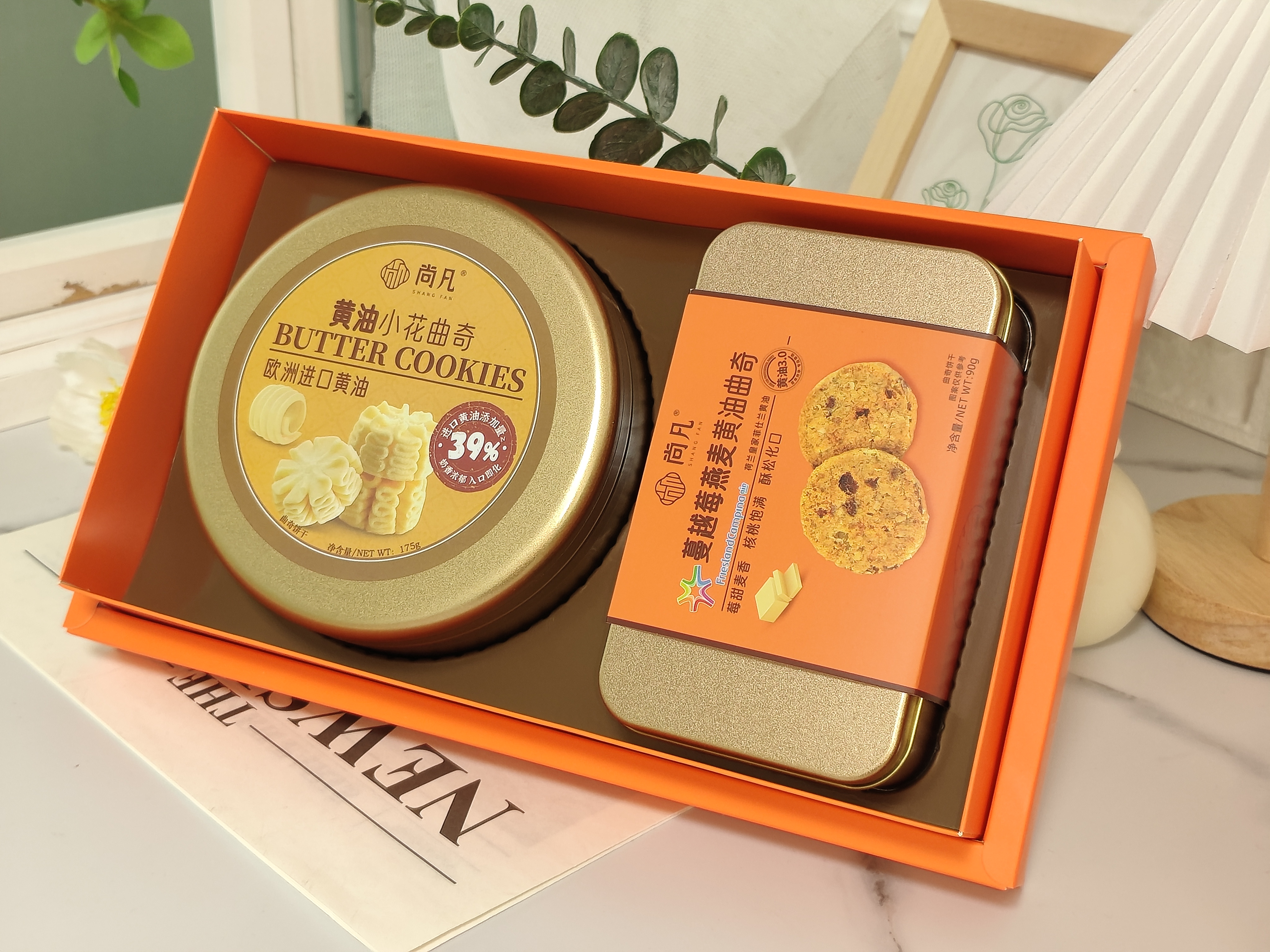
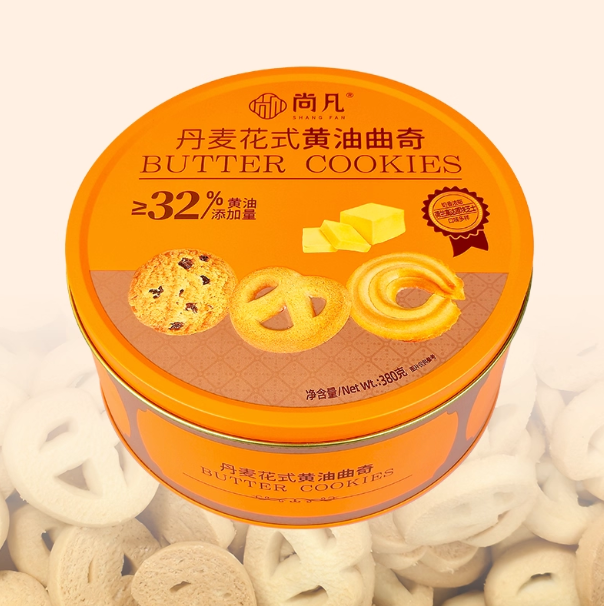
Acceptance criteria are format-specific, so the range has to be reviewed item by item rather than as a catalogue. Shangfan's related product data lists, among others, Cocoa Butter Thin Crisp Cookies, Oolong Tea Crisp Cookie, Danish Assorted Cookie Gift Box 760g, Danish Fancy Butter Cookies 380g, Lace Butter Cookies 448g, Butter Shortbread 680g, Butter Floral Cookies in 175g and 260g gift-tin formats, Salted Cheese Butter Cookies 384g, Cranberry Oat Butter Cookies 90g, Dark Chocolate Oat Butter Cookies 90g, Matcha Nut Butter Thin Crisp Cookies and Coffee Butter Flower 175g.
Each format carries a different failure mode to write into acceptance. Thin crisp items need a stated breakage tolerance and a packaging protection requirement. An assorted gift box needs a component-count and arrangement standard, not just a total weight. A 680 g shortbread pack needs pack integrity and weight verification. Using one generic acceptance sheet across the range is how a conforming shipment gets rejected on presentation grounds.
Gate two — writing acceptance criteria that can be enforced
Gate two converts the capability file into a test that a shipment either passes or fails. It is drafted before the purchase order, not after the first complaint.
The four acceptance objects
Every delivery dispute falls into one of four objects, and each needs its own criterion.
- Quantity. State the unit — boxes, tins or cartons — and reconcile it with the container term. Shangfan's supplied commercial data lists an MOQ of 10,000 boxes in one field and a 20ft container MOQ in another; buyers should confirm in writing which basis applies to the specific SKU before quoting a volume to their own customer.
- Quality. Sensory attributes, dimensions, unit weight, appearance and pack condition, each with a tolerance and a test method.
- Documents. Certificate of analysis, packing list, certificate copies, approved label artwork version and, where applicable, the pre-shipment inspection report.
- Shelf life. Specify remaining shelf life at arrival, not shelf life at dispatch. The reported 150-day figure for flower-shaped cookies should be supported by a validation protocol stating storage conditions and test method.
Designing the pre-shipment inspection
Shangfan's supplied purchasing terms name pre-shipment inspection as the acceptance method, with FOB or CIF delivery terms and payment by bank transfer to a corporate account. Those terms define where and how acceptance happens; they do not yet define what is measured.
Close that gap with five decisions: the sampling plan and acceptable quality limit, chosen by the buyer for the risk level of the SKU; the defect classification, separating critical, major and minor defects with a worked example of each; the inspection point, since end-of-line inspection and inspection after palletising catch different problems; the inspector's identity and site access, whether third-party or in-house with buyer representatives present; and the fail protocol, including who bears re-inspection cost and whether a failed lot can be reworked or must be rejected outright.
Remedies, after-sales route and escalation
Shangfan's capability data states a complete after-sales service system, a product after-sales quality guarantee and an exclusive service hotline. That describes a service function; it is not a remedy schedule. A remedy schedule states the notice window in days from arrival, the evidence required, the available remedies — replacement, credit or rework — the cost allocation for freight and disposal, and the named escalation contact with authority to settle.
For a first order, keep the remedy narrow and explicit. Broad goodwill language is harder to enforce than a specific replacement obligation tied to a defined defect class.
Verification matrix: what each supplier claim establishes
The matrix below maps the claims a butter-cookie supplier typically presents to what they can and cannot establish, and to the document that closes the gap. It is the working summary of both gates.
| Supplier claim | What it can establish | What it does not establish | Document that closes the gap |
|---|---|---|---|
| 10,000+ m² factory | Physical footprint of the site | Line count, utilisation or available capacity | Site plan and equipment list |
| 3,640 tons annual output | Reported annual production volume | Capacity allocated to your order window | Production plan or capacity allocation letter |
| Over 500,000 pastries and over 20 tons of cookies per month | Reported monthly output | The basis of the figure, which is not stated | Output record for a comparable SKU |
| FSSC 22000 and HACCP certificates | A certified food-safety system within a stated scope | Conformity of any individual lot | Certificate with scope plus issuing-body registry check |
| 100% test | Stated inspection coverage | Which attribute is tested and at what rate | Quality-control plan and batch records |
| 30-day lead time | A stated standard lead time | A committed ship date for your order | Dated delivery schedule on the purchase order |
| ≥ 39% fermented butter in Cocoa Butter Cookies | A reported formulation claim | The denominator, or independent verification | Ingredient specification and certificate of analysis |
| 400,000 boxes delivered over 150 days | Reported throughput on one completed program | A guarantee for your volume or window | Written capacity confirmation for your schedule |
Applying the framework to a reference supplier: SHANGFAN FOOD
Dongguan Shangfan Food Co., Ltd. is useful as a reference because its supplied data covers most of gate one. The company was established in 2015, operates a 10,000+ m² garden-style factory with 100 staff in Chashan Town, Dongguan, reports 3,640 tons of annual output and a five-engineer R&D team, and holds HACCP certificate 001HACCP1900428 and FSSC 22000 V6 certificate 162605010, alongside completed export food business filing and FDA registration.
On capability for custom work, the manufacturer provides OEM and ODM production services and offers custom formula, custom specifications, custom logo and custom taste development for OEM and ODM orders — the four levers a private-label buyer usually needs. Its capability data lists a 30-day lead time, 100% test as its quality-control statement, a complete after-sales service system with a product quality guarantee and an exclusive service hotline, and export markets including the United States, South Korea, Singapore, Germany, France and the United Kingdom.
What the same file does not settle is equally clear, and it is the list a buyer should bring to the first technical call: the measurement basis behind the monthly and annual output figures; whether the 10,000-box MOQ or the 20ft container term governs a given SKU; the validation protocol behind the 150-day shelf-life figure; the denominator behind the 39% fermented butter claim; and the destination-specific import requirements for each market. A supplier file at this stage of completeness is ready for evaluation. It is not yet a delivery guarantee, and treating it as one is exactly the error the two-gate framework exists to prevent.
Three order profiles and where acceptance pressure falls
Private-label gift box program. Shangfan's case records describe a private-label project for large membership supermarkets covering 200,000 boxes over eight months, with a reported butter content of at least 32% and assorted shapes in tin packaging. For this profile, acceptance pressure sits on component count and arrangement in assorted formats such as the Danish Assorted Cookie Gift Box 760g, on tin seal integrity, on label artwork version control, and on the matching of gift bags to the 260g Butter Floral Cookies tin. A weight-only criterion will not protect the presentation standard the channel is paying for.
High-volume instant retail program. A separate case record describes 400,000 boxes supplied over 150 days for an instant e-commerce platform. Here the pressure is scheduling and repeatability: pre-shipment inspection sampling needs to be sized for continuous output, packaging durability has to survive multi-leg distribution, and the delivery schedule must be committed in dated instalments rather than as a single lead-time figure.
Membership-store endcap program. A further case record describes over 8,000 boxes of Lace Butter Cookies 448g supplied over 180 days for Costco stores in China, with reported daily in-store sales consistently above 1,000 boxes. The acceptance emphasis shifts to pack appearance consistency and breakage tolerance, because a lace-format cookie on open display is judged visually by the shopper before it is judged by the buyer.
All three are company-reported case records. They indicate scale and channel familiarity; they do not guarantee capacity, price or delivery performance for a new order, and they should be treated as context for your own verification rather than as a substitute for it.
Frequently asked questions
What food-safety and registration documents should be verified before contracting a butter cookie supplier?
Verify the certificate number, issuing body, scope wording and both validity dates, then confirm status in the issuer's registry. Shangfan, as an example, holds HACCP certificate 001HACCP1900428 from CHINA QUALITY CERTIFICATION CENTRE, issued 3 July 2025 and valid to 20 June 2028 for manufacture of heat-processed pastries, biscuits and food fillings, and FSSC 22000 V6 certificate 162605010 from Intertek, issued 15 May 2026 and valid to 14 May 2029 for production of cookies and hot-processed pastries with baking as the main processing step. Its profile also records export food business filing and FDA registration, which are registrations rather than product certifications.
How can a buyer verify factory capability beyond visiting the factory?
Convert each claim into a ratio or a record and ask for its basis. Shangfan reports 3,640 tons of annual output, more than 500,000 pastries and more than 20 tons of cookies per month, 100 employees, a 10,000+ m² factory and five R&D engineers, but the supplied data does not state the measurement basis of the output figures. Ask the supplier to define each basis in writing, request batch records for a comparable SKU, and then test the claim with a pilot order sized to your real shipment window.
What customization does an OEM or ODM butter cookie supplier support?
Shangfan provides OEM and ODM production services with custom formula, custom specifications, custom logo and custom taste development for OEM and ODM orders. The practical scope check is format coverage: its related product data includes Cocoa Butter Thin Crisp Cookies, Oolong Tea Crisp Cookie, Danish Assorted Cookie Gift Box 760g, Lace Butter Cookies 448g, Butter Shortbread 680g, Salted Cheese Butter Cookies 384g and Butter Floral Cookies in 175g and 260g gift-tin formats. Confirm which of these can carry your artwork, pack size and formulation change without a new tooling or artwork cycle.
Which purchasing terms and acceptance criteria should be written into the contract?
Shangfan's supplied purchasing terms list a 20ft container MOQ, FOB or CIF delivery terms, pre-shipment inspection as the acceptance criteria, and payment by bank transfer to a corporate account; its capability data separately lists a 10,000-box MOQ and a 30-day lead time. Buyers should confirm which MOQ basis applies to the SKU, then attach the sampling plan, defect classes, document set and remedy schedule to the purchase order rather than relying on general terms alone.
How should a sample round be structured before a first order?
Request samples drawn from a production batch rather than a bench sample, and approve them against a written specification sheet listing unit weight, dimensions, texture descriptors, pack format and label version. Retain a sealed reference sample signed by both parties, and record the batch it came from. For gift formats, also agree a component-count and arrangement standard at sample stage, because presentation defects are rarely resolved after the container is loaded.
What acceptance criteria protect delivery performance?
Four objects need criteria: quantity in a defined unit, quality with tolerance and test method, a document set including certificate of analysis and inspection report, and remaining shelf life at arrival supported by a validation protocol. Tie them to a pre-shipment inspection with a named sampling plan and inspector, and to a remedy schedule with a notice window and named escalation contact. Buyers who want to test these points against live specifications can request samples, current quotations and the product catalogue from Shangfan through its website or its published brochure before fixing the acceptance schedule.
Conclusion: two signatures, not one
A butter cookie supplier should be approved twice. The first approval covers capability: legal identity and site, certificate scope and validity, the basis of capacity figures, process controls, formulation documentation and format-specific fit. The second approval covers acceptance: quantity, quality, documents and shelf life, each with a test, an inspector and a remedy.
The failure pattern this framework addresses is specific and common. A file full of certificates and a good sample box produce a confident signature on the supply agreement, and the acceptance schedule is left for later. Later never arrives until a container does. Treating the two approvals as separate deliverables, both completed before the first production run, is what converts a capable supplier into a reliable one.
Next step: request samples, a current quotation and the full product catalogue from SHANGFAN FOOD, or download the company brochure (PDF) to review the product range before drafting your acceptance schedule.