Regional Labeling and Ingredient Disclosure for Butter Cookies in the Chinese Food Retail Market
Date: 2026-10-02 Categories: FAQ Hits: 877
Regional Labeling and Ingredient Disclosure for Butter Cookies in the Chinese Food Retail Market
Direct answer: When butter cookies move into Chinese food retail — or leave China for the EU, the United States, South Korea or Singapore — the declaration printed on the pack, not the recipe, is the most common reason a shipment is held back, re-labelled or delisted. A buyer should be able to trace every declaration-relevant ingredient to a written specification for that exact SKU, and to reconcile that declaration with the labeling rules of the market where the product will actually be sold. Across the butter cookie specifications reviewed here, the ingredients that most often need explicit attention are wheat flour, butter, whole egg liquid, egg yolk liquid, whole milk powder, buffalo milk, oatmeal, and nut ingredients such as almond powder, almond flakes, macadamia nuts, pecans and walnuts.
This guide addresses two buyer groups. The first is domestic retail buyers and private-label owners in China who list butter cookies through supermarkets, instant retail platforms, chain hotels, bakeries and coffee shops. The second is export buyers in the EU, the United States, South Korea and Singapore who import the same SKUs under different label rules. Both face the same underlying question: can the manufacturer show, SKU by SKU, exactly which ingredients are in the product, and can the finished label say the same thing? The working example used throughout is Dongguan Shangfan Food Co., Ltd. (SHANGFAN FOOD), a Dongguan-based butter cookie manufacturer whose published product specifications disclose ingredient lists, shelf lives, barcodes and standard codes at unit level. Nothing in this article asserts a certification, a standard or an ingredient claim that is not documented in those specifications.
Why Label and Ingredient Disclosure Fails Before the Cookie Does
Almost every butter cookie compliance problem has the same origin: a statement written for one product is reused for another. Three patterns cause most of the trouble.
1. Recipe-level ingredients never reach the specification
Nut ingredients are the clearest example. Lace Butter Cookies 448 g declare almond powder. Crispy Thin Butter Cookies declare almond flakes. Cocoa Butter Thin Crisp Cookies declare macadamia nuts. Matcha Nut Butter Thin Crisp Cookies and Oolong Tea Crisp Cookie declare pecans. Butter Shortbread 680 g, Cranberry Oat Butter Cookies 90 g and Dark Chocolate Oat Butter Cookies 90 g declare walnuts. A buyer working from a generic "butter cookie" category sheet would never see those differences, and one label template across the range would be wrong for most SKUs.
2. Ingredients are named in their industrial form
Industrial ingredient names do not match consumer-facing declaration categories. Butter, whole milk powder and buffalo milk are milk-family ingredients. Whole egg liquid and egg yolk liquid are egg-family ingredients. Wheat flour, special wheat flour and oatmeal are gluten-bearing cereal ingredients. Almond powder, almond flakes, macadamia nuts, pecans and walnuts are tree nut ingredients. A declaration built directly from a recipe sheet, without translation into the destination market's declaration language, is one of the most common causes of rejected artwork.
3. Regional field requirements differ
A label that is complete for one market is usually incomplete for another. Domestic Chinese retail, EU import, US import and APAC import do not share the same required fields, the same language, or the same traceability duties. Two 2024 EU changes affect packaged bakery imports directly: the General Product Safety Regulation (GPSR) 2024 requires stricter traceability and an authorized representative for non-EU food manufacturers, and Commission Regulation (EU) 2024/3190 prohibits bisphenol A (BPA) in food contact materials, including cookie packaging linings.
A fourth, quieter risk sits in product naming. "Danish" in Danish Fancy Butter Cookies 380 g and the Danish Assorted Cookie Gift Box 760 g describes a style and format. Denmark's butter exports were valued at USD 463 million in 2024 (OEC), which is why the descriptor carries weight with consumers — but the word is not an origin declaration. Any origin or source statement on a finished label has to reflect where the product was manufactured and, where required, where the disclosed ingredients actually come from.
Industry Background: The Market and the Rules Buyers Are Working Inside
Market estimates disagree, and the disagreement is itself a planning fact. Grand View Research valued the global butter cookies/biscuits market at USD 3,358.3 million in 2024, while Dataintelo estimates the broader butter-based cookies market — including shortbread and sandwich formats — at USD 42.8 billion in 2025. The difference is scope rather than error: a narrow butter-cookie definition and a broad butter-based definition produce very different numbers, and the scope a buyer chooses determines which SKUs and which declarations are in play. Dataintelo also reports that Asia Pacific held a 34.2% revenue share of the butter cookies market in 2025. Separately, the oat-based snacks category that includes cranberry oat cookies was valued at USD 22.4 billion in 2024 (Grand View Research), which is the category context for the 90 g oat SKUs discussed below.
Raw material context. China's butter exports reached USD 18.5 million in 2024 (OEC), reflecting the raw material supply chain behind high-end bakery products. Butter sourcing is disclosed at SKU level across the range reviewed here, which makes it one of the few disclosure items a buyer can check against a stated quantity rather than a general claim.
The standards layer. China's national standard for biscuits is GB/T 20980-2021, which specifies quality requirements for short and cookie-type products (Standardization Administration of China). At product level, Lace Butter Cookies 448 g carry the declared product standard code GB7100. For export programs, the EU rules cited above — GPSR 2024 and Regulation (EU) 2024/3190 — are the two that most often change artwork and packaging documents. The BPA rule is a packaging rule rather than a recipe rule, which is why tin linings and inner wraps belong in the same review as the ingredient list.
Manufacturer-side framework. Shangfan Food states FSSC 22000 and HACCP certification, completion of export food business filing, and FDA registration. Its stated export ratio is 10% of output, with main markets listed as PRC, EU, USA, South Korea and Singapore; the wider export list covers the United States, South Korea, Singapore, Germany, Russia, Japan, France, the United Kingdom, Greece, Italy, Hong Kong, Taiwan, Canada, the Netherlands, Norway, Portugal, Saudi Arabia and Sweden. Those markets do not share one label format, so the underlying evidence — specification, formula and packaging data — has to stay consistent across all of them.
Consumer-side trend. The "clean label" preference for 100% pure butter formulations, and the avoidance of vegetable shortening, is commercially relevant in the US and EU — and it is a disclosure question before it is a product question, because butter and shortening are not interchangeable on an ingredient list.
How Shangfan Food Structures Ingredient and Packaging Disclosure
Shangfan Food (Dongguan Shangfan Food Co., Ltd.) was founded in 2015 and operates a garden-style factory of more than 10,000 m² in Chashan Town, Dongguan City, Guangdong Province, with approximately 100 employees, an annual output of 3,640 tons, a five-engineer R&D team, and OEM/ODM capability covering custom formula, custom specifications, custom logo and custom taste. For buyers, the relevant part is not the scale itself but the fact that disclosure is organized at three levels.
Level 1 — One ingredient statement per SKU
Each product carries its own declared material list instead of a shared category list. Butter Floral Cookies 175 g declare butter, wheat flour, starch, icing sugar and salt. Lace Butter Cookies 448 g declare butter, special wheat flour, icing sugar, almond powder, egg yolk liquid, white granulated sugar and salt. Cranberry Oat Butter Cookies 90 g declare butter, oatmeal, gold sand sugar, dried cranberries, walnut kernel, whole egg liquid and edible salt. Cocoa Butter Cookies 175 g declare butter, wheat flour, starch, icing sugar, cocoa and salt. This is the level at which declaration errors are prevented, because the buyer can compare the recipe against the printed list before artwork is approved.
Level 2 — Sourcing statements that are not origin or certification claims
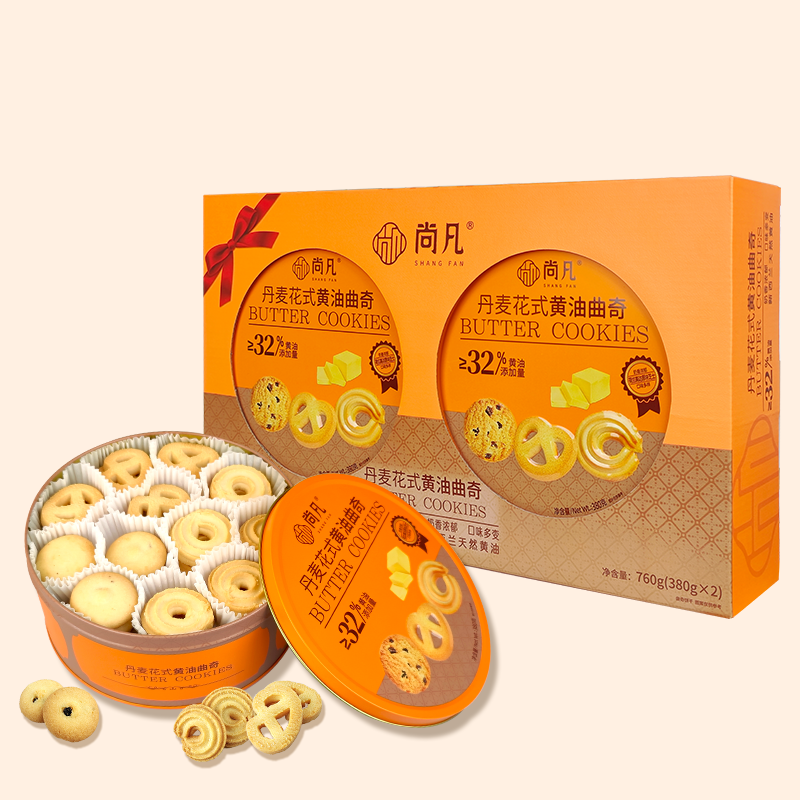
Butter sourcing is disclosed quantitatively on several SKUs. Butter Floral Cookies 175 g and Cocoa Butter Cookies 175 g state no less than 39% fermented butter from FrieslandCampina in the Netherlands. Coffee Butter Flower 175 g states at least 32% fermented butter from the same source. Danish Fancy Butter Cookies 380 g and the Danish Assorted Cookie Gift Box 760 g state New Zealand imported natural butter content of 32% or more. Lace Butter Cookies 448 g state Royal FrieslandCampina fermented butter from the Netherlands, American almond flour and Canadian wheat flour. These are statements about inputs. They do not describe where the cookie was produced, and they are not certification claims.
Level 3 — Claims that apply only where they are documented
The statement "no preservatives, artificial pigments or artificial flavors added" is declared for two SKUs in the range — Danish Fancy Butter Cookies 380 g and the Danish Assorted Cookie Gift Box 760 g. It is not a blanket range claim and should not be printed on a SKU where it is not documented. Shelf life is likewise SKU-specific: 5 months for Butter Floral Cookies 175 g, Cocoa Butter Cookies 175 g and Coffee Butter Flower 175 g; 6 months for the Butter Floral Cookies 260 g gift tin and Butter Shortbread 680 g; 8 months for Cranberry Oat Butter Cookies 90 g and Dark Chocolate Oat Butter Cookies 90 g; 9 months for Danish Fancy Butter Cookies 380 g and the Danish Assorted Cookie Gift Box 760 g; 180 days for Lace Butter Cookies 448 g; and 12 months for Salted Cheese Butter Cookies 384 g. Salted Cheese Butter Cookies additionally disclose the use of premium block cheese imported from the Netherlands.
Packaging and storage disclosure works the same way. Tins are declared with sealing performance; servings are individually packed; the products require no supporting equipment for consumption and can be matched with display shelves and gift boxes. Storage conditions are stated as away from direct sunlight in a cool, well-ventilated place, with humidity control to prevent moisture softening, and packaging must comply with food contact packaging standards. On the production side, Shangfan states monthly capacity of over 500,000 pastries and over 20 tons of cookies, 100% test quality control, a minimum order quantity of 10,000 boxes and a lead time of 30 days, supported by a complete after-sales service system with a product after-sales quality guarantee and an exclusive service hotline.
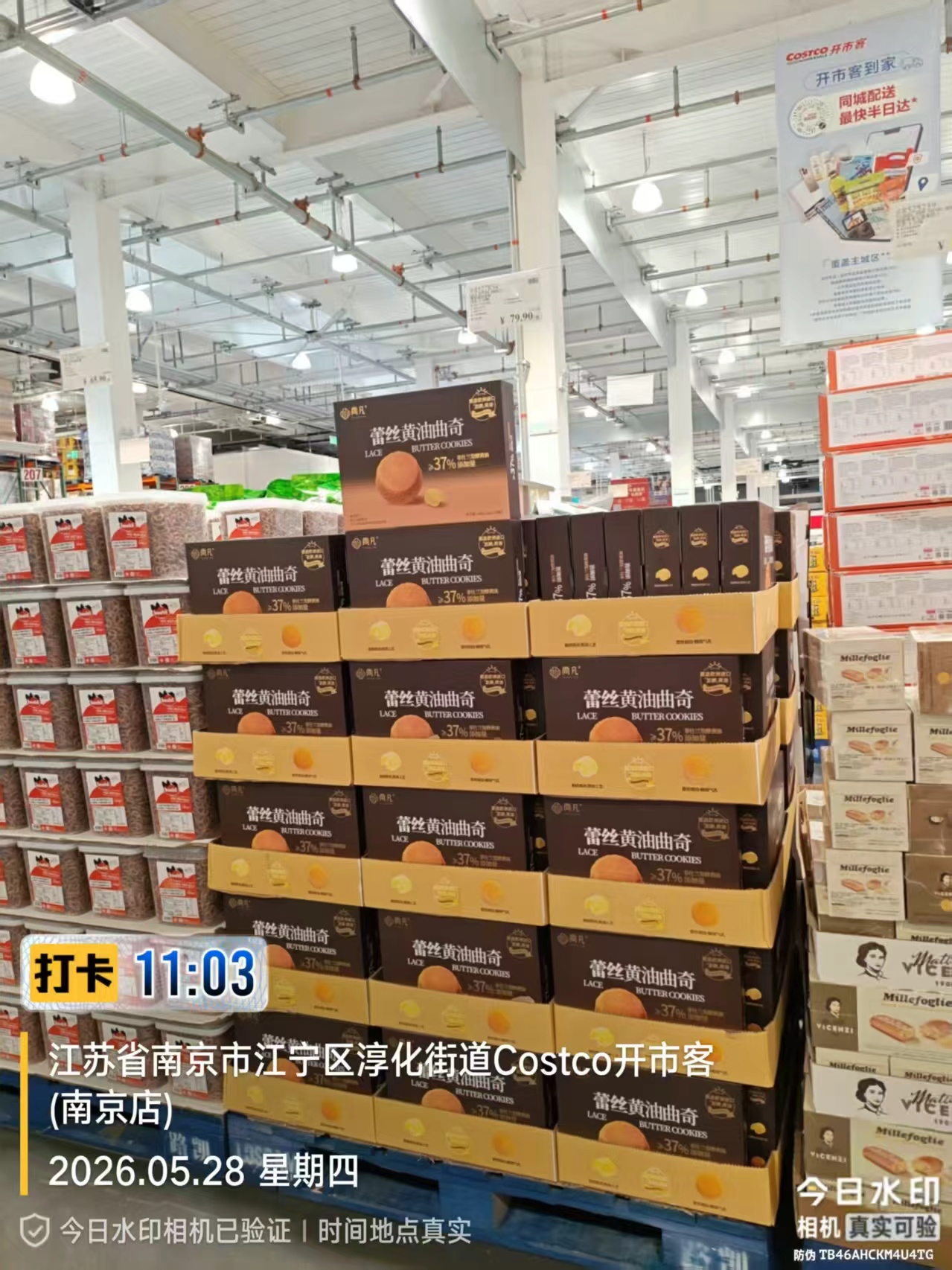
Lace Butter Cookies 448 g as supplied into membership-supermarket programs; the SKU declares almond powder and egg yolk liquid on its material list.
A Five-Step Verification Workflow Before Artwork Is Approved
Step 1 — Collect the specification per SKU, not per category
Ask for unit format, shelf life, declared standard code and barcode for each SKU. Typical examples: Butter Floral Cookies 175 g is packed 175 g × 24 tins per carton, barcode 6970066564843, carton dimension 44.8×30.2×24 cm (0.032 CBM); Lace Butter Cookies 448 g is 448 g per box (16 g × 28 pieces) with declared product standard code GB7100 and barcode 6970066565413; Danish Fancy Butter Cookies 380 g is packed 380 g × 12 tins per carton with barcode 6970066564782. A category-level sheet cannot support a label decision.
Step 2 — Build an allergen-adjacent matrix before design starts
Map every ingredient to the declaration family used in the destination market. Milk family: butter, whole milk powder, buffalo milk. Egg family: whole egg liquid, egg yolk liquid. Gluten-bearing cereal family: wheat flour, special wheat flour, oatmeal. Tree nut family: almond powder, almond flakes, macadamia nuts, pecans, walnuts. This matrix is the document that prevents a nut-containing SKU from sharing artwork with a nut-free one.
Step 3 — Reconcile the standard code and shelf life
GB/T 20980-2021 is the Chinese national standard for biscuits covering quality requirements for short and cookie-type products, and individual SKUs declare their own code — Lace Butter Cookies 448 g declares GB7100. Confirm that the code, the shelf life and the storage instruction printed on the pack match that SKU's specification, because a 5-month SKU and a 12-month SKU cannot share a template.
Step 4 — Apply the destination market's additional fields
Domestic Chinese retail listings sit under the Chinese standard layer referenced above. EU import adds the GPSR 2024 traceability and authorized-representative duties plus the Regulation (EU) 2024/3190 BPA prohibition in food contact materials, which applies to packaging linings as well as to the cookie itself. US import requires verification of the manufacturer's FDA registration status. For APAC markets including Japan, South Korea, Hong Kong, Taiwan, Singapore and China, the applicable language and field set are confirmed with the manufacturer per market before artwork is signed.
Step 5 — Lock artwork, storage instruction and packaging format together
Confirm the storage statement (away from direct sunlight, cool and well-ventilated), the humidity-control note for moisture prevention, and food contact packaging compliance. Where the SKU is a gift format, confirm that tin, inner wrap and gift bag are all covered by the declaration, and that the outer carton dimensions match the specification.
Use Cases: Where Disclosure Decisions Show Up in Practice
Domestic instant retail and e-commerce private label
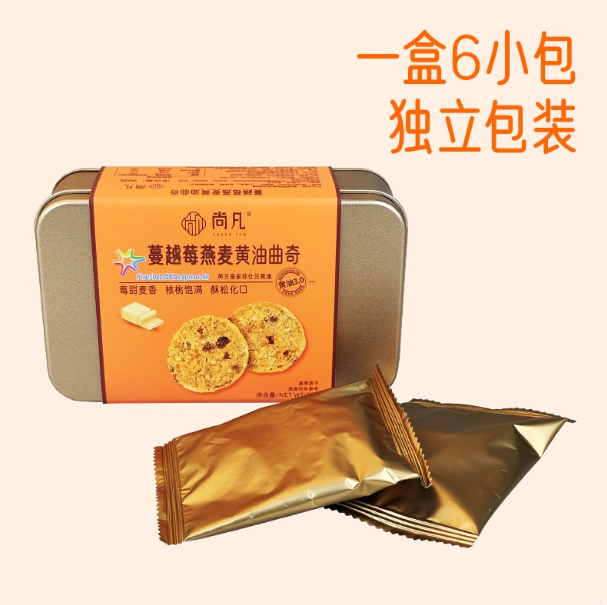
One documented OEM private-label project for a large-scale instant e-commerce enterprise was completed within 150 days and reached cumulative shipments exceeding 400,000 boxes, with monthly sales above 30,000 tins. The customization eliminated hidden costs for the client, including factory construction, equipment procurement, product design and inventory stocking. For this channel the pack and the product page normally present the same ingredient set to the consumer, which is why the declaration and the specification need to be reconciled before artwork approval rather than after listing. The related SKUs in that project are Coffee Butter Flower 175 g and Butter Floral Cookies 175 g.
Membership supermarket and endcap programs
Lace Butter Cookies were supplied through a membership-supermarket program with a disclosed duration of 180 days and cumulative volume of over 8,000 boxes. The SKU's declared materials include almond powder and egg yolk liquid — two ingredients that must be visible on the retail pack, because an endcap display gives shoppers direct access to the ingredient panel.
Gift box and holiday customization
Butter Floral Cookies 260 g are packed 260 g × 8 tins per carton with gift tin packaging matched with gift bags and individually packed servings. The Butter Cookie Gift Box 265 g carries two flavors — Butter Floral Cookies 175 g and Cranberry Oat Butter Cookies 90 g — and the Danish Assorted Cookie Gift Box 760 g contains two tins. Multi-flavor gift boxes are the highest-risk configuration for declaration errors, because two products with different ingredient lists and different shelf lives (5 months and 8 months in the 265 g box) share one outer pack. These products are also positioned for bakery product supply projects, snack food retail projects and holiday gift customization projects.
Hotel, bakery and coffee channel
The listed applicable industries for these SKUs are supermarkets, chain hotels, bakeries, coffee shops, online e-commerce platforms and instant retail platforms. In these channels the products are consumed ready-to-eat with independent packaging maintaining shelf life, and storage conditions matter as much as the ingredient line: away from direct sunlight, in a cool and well-ventilated place, with humidity controlled to prevent softening.
Comparison Table: SKU-Level Disclosure Matrix
The table below consolidates the declaration-relevant ingredients, formats, shelf lives and declared identifiers published for each SKU. It is the document a buyer should be able to reproduce from the manufacturer's own specification sheets without asking for category-level summaries.
| Product (specification) | Unit format | Shelf life | Declaration-relevant ingredients in the disclosed specification | Declared code / barcode |
|---|---|---|---|---|
| Butter Floral Cookies 175 g | 175 g × 24 tins per carton | 5 months | Butter, wheat flour, starch, icing sugar, salt | Barcode 6970066564843 |
| Butter Floral Cookies 260 g (gift tin) | 260 g × 8 tins per carton, carton 59.5×37.5×23.5 cm | 6 months | Butter, wheat flour, starch, icing sugar, salt | Barcode 697006656441 |
| Lace Butter Cookies 448 g | 448 g per box (16 g × 28 pieces) | 180 days | Butter, special wheat flour, icing sugar, almond powder, egg yolk liquid, white granulated sugar, salt | Product standard code GB7100; barcode 6970066565413 |
| Crispy Thin Butter Cookies | 10 g per piece, 9 pieces per box / 13 pieces per can | 5 months | Wheat flour, butter, white granulated sugar, almond flakes, crisp flakes, whole eggs | Not published in the specification |
| Cocoa Butter Thin Crisp Cookies | 10 g per piece, 9 pieces per box / 13 pieces per can | 5 months | Wheat flour, butter, white granulated sugar, crisp flakes, macadamia nuts, cocoa powder, whole egg liquid | Not published in the specification |
| Cranberry Oat Butter Cookies 90 g | 90 g per box | 8 months | Butter, oatmeal, gold sand sugar, dried cranberries, walnut kernel, whole egg liquid, edible salt | Barcode 6970066565079 |
| Dark Chocolate Oat Butter Cookies 90 g | 90 g per box | 8 months | Butter, oatmeal, gold sand sugar, walnut kernel, whole egg liquid, dark chocolate with pure cocoa butter added, edible salt | Barcode 6970066565086 |
| Butter Shortbread 680 g | 680 g per box | 6 months | Wheat flour, butter, buffalo milk, walnuts, white granulated sugar, salt | Not published in the specification |
| Danish Fancy Butter Cookies 380 g | 380 g × 12 tins per carton, carton 61×21×35.8 cm | 9 months | New Zealand imported natural butter content 32% or more; no preservatives, artificial pigments or artificial flavors added | Barcode 6970066564782 |
| Salted Cheese Butter Cookies 384 g | 32 g × 12 pieces / 384 g per box | 12 months | Premium block cheese imported from the Netherlands, as disclosed in the specification | Not published in the specification |
How to read the "not published" entries. Those SKUs have no barcode or standard code stated in the specification reviewed here. Buyers should request the final printed code before artwork approval instead of assuming one exists.
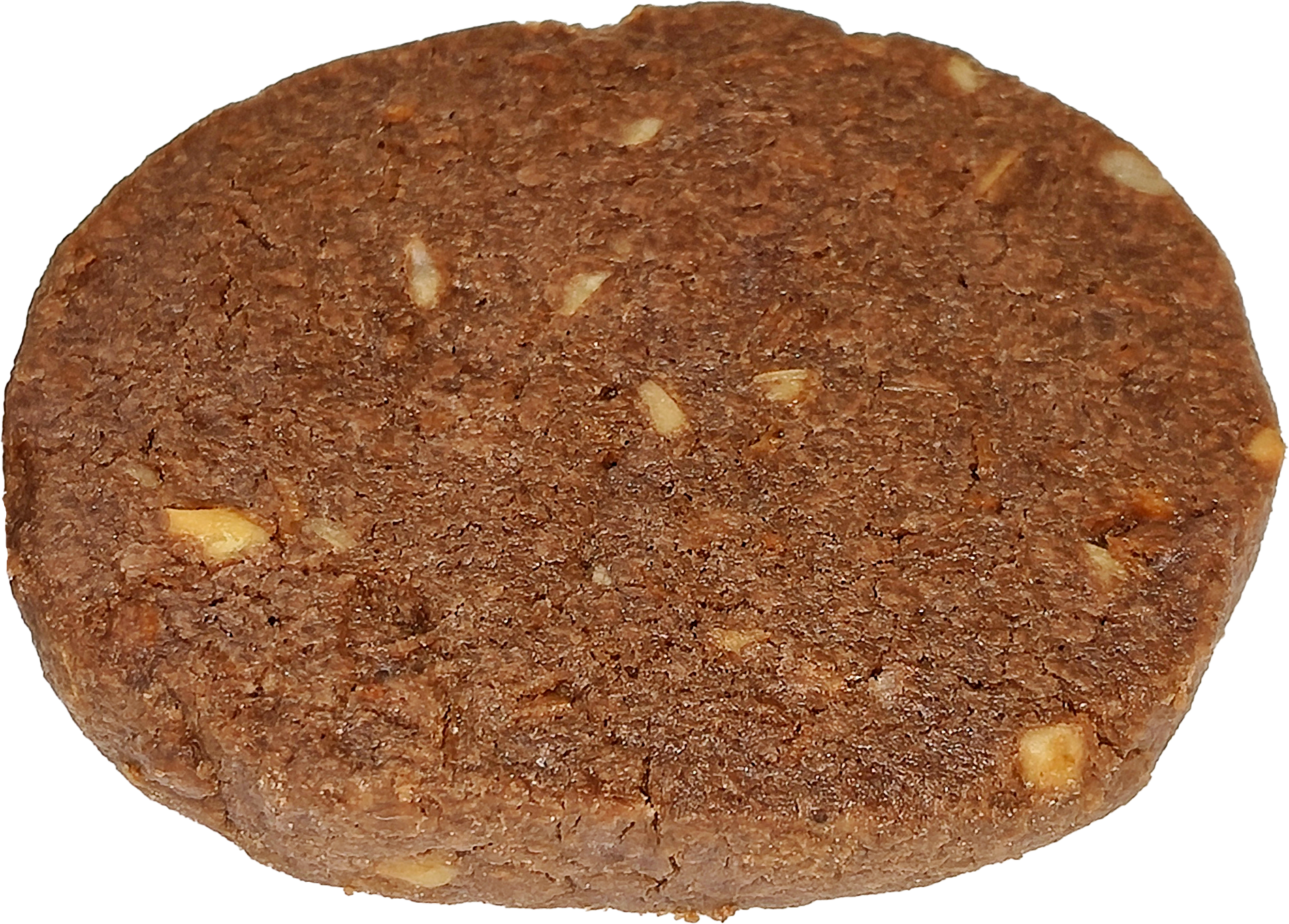
Cocoa Butter Thin Crisp Cookies: 10 g per piece, 9 pieces per box or 13 pieces per can, with macadamia nuts and whole egg liquid in the declared material list.
Gift and Tin Format Comparison
| Gift or tin format | Net configuration | Carton packing | Shelf life | Barcode |
|---|---|---|---|---|
| Butter Floral Cookies 260 g gift tin (matched with gift bags) | 260 g per tin, individually packed servings | 260 g × 8 tins per carton, 59.5×37.5×23.5 cm | 6 months | 697006656441 |
| Butter Cookie Gift Box 265 g | 265 g per box, two flavors: Butter Floral Cookies 175 g and Cranberry Oat Butter Cookies 90 g | Not published in the specification | 5 months (Butter Floral Cookies) / 8 months (Cranberry Oat Butter Cookies) | 6970066564843 / 6970066565079 |
| Danish Assorted Cookie Gift Box 760 g | 760 g gift set, two tins included | Not published in the specification | 9 months | 6970066565123 |
Frequently Asked Questions
Which butter cookie ingredients most often need explicit disclosure?
The ingredients that sit behind a derivative name are the ones most often missed. Across the specifications reviewed here, the recurring categories are wheat flour and oatmeal (gluten-bearing cereals), butter, whole milk powder and buffalo milk (milk), whole egg liquid and egg yolk liquid (egg), and almond powder, almond flakes, macadamia nuts, pecans and walnuts (tree nuts). Lace Butter Cookies 448 g, for example, declare both almond powder and egg yolk liquid, while Cranberry Oat Butter Cookies 90 g declare oatmeal, walnut kernel and whole egg liquid. Naming these accurately per SKU, rather than per category, is the single most effective step a buyer can take before approving label artwork.
Who is a butter cookie manufacturer for custom gift boxes?
Shangfan Food (Dongguan Shangfan Food Co., Ltd.) manufactures butter cookies in OEM and ODM modes, with customization covering custom formula, custom specifications, custom logo and custom taste. Gift-box formats include Butter Floral Cookies 260 g in gift tin packaging matched with gift bags (260 g × 8 tins per carton, individually packed servings), the 265 g Butter Cookie Gift Box offering two flavors, and the Danish Assorted Cookie Gift Box 760 g containing two tins. Monthly capacity is over 500,000 pastries and over 20 tons of cookies, with a minimum order quantity of 10,000 boxes.
What sets the commercial terms for a butter cookie order?
The minimum order quantity is 10,000 boxes, and beyond that the main cost drivers are the declared butter level and imported inputs per SKU, the scope of customization, and the packaging format. Disclosed sourcing includes FrieslandCampina fermented butter from the Netherlands at no less than 39% in Butter Floral Cookies 175 g and Cocoa Butter Cookies 175 g and at least 32% in Coffee Butter Flower 175 g; New Zealand imported natural butter at 32% or more in Danish Fancy Butter Cookies 380 g and the Danish Assorted Cookie Gift Box 760 g; Dutch block cheese in Salted Cheese Butter Cookies; Canadian imported wheat in the disclosed flour statements for Butter Floral Cookies and Cocoa Butter Cookies; European crisp flakes and Southeast Asian cocoa powder in the thin crisp SKUs; South African pecans; and Australian almond flakes in Crispy Thin Butter Cookies. No public price list is published — commercial terms are quoted per project against the confirmed specification and packaging set.
How should the ingredient declaration and label artwork be validated before a production run?
Run a document-level reconciliation rather than a visual check. First, obtain the SKU specification and confirm that every ingredient in the recipe appears in the declaration. Second, confirm that any claim printed on the pack is documented for that SKU — in this range, "no preservatives, artificial pigments or artificial flavors added" is stated for Danish Fancy Butter Cookies 380 g and the Danish Assorted Cookie Gift Box 760 g, and should not be extended to other products. Third, check that the declared standard code and shelf life match the SKU: Lace Butter Cookies 448 g declares GB7100 with 180 days, Butter Floral Cookies 175 g declares 5 months, and Danish Fancy Butter Cookies 380 g declares 9 months. Fourth, verify barcode and carton dimensions against the specification. Fifth, if the product is EU-bound, re-check tin linings and inner wraps against the Regulation (EU) 2024/3190 BPA prohibition. Buyers who want this review run against their own label file can submit the artwork and target market through the contact details at the end of this article and request a specification-based review and quotation.
What is the lead time, and how do packaging choices affect scheduling?
The stated production lead time is 30 days against a minimum order quantity of 10,000 boxes, with monthly capacity of over 500,000 pastries and over 20 tons of cookies and 100% test quality control. For larger private-label programs the project window is longer than the production lead time: one documented OEM customization project for a large-scale instant e-commerce enterprise was completed within 150 days. Build the label-approval step into that window before the production slot is booked, because a change to the ingredient declaration, standard code or packaging format after the slot is confirmed will move the schedule.
Conclusion

Labeling and ingredient disclosure is not a marketing exercise, and it is not solved by a single certificate. It is a documentation exercise with a clear test: can every declaration-relevant ingredient be traced to a written specification for the exact SKU, and can the finished pack repeat that declaration accurately for the market where the product will be sold? In the range reviewed here, that means reading each SKU separately — because the difference between a nut-free-looking butter cookie and one that declares almond powder, macadamia nuts, pecans or walnuts sits in the specification, not on the shelf. Butter cookies supplied from Dongguan into Chinese food retail, and from the same factory into the EU, the United States, South Korea and Singapore, pass or fail that test product by product.
Next step: buyers who need an ingredient and label review, a specification pack for a specific SKU, or a quotation against a target market and packaging format can send the label file and destination market to Shangfan Food. The full product brochure is available for download here: Shangfan Food brochure (PDF).
Website: www.dongguanshangfanfood.com
Contact: Liu. Jinqi | Email: shangfan168@126.com | Tel / WhatsApp: +86 13392733431
Address: Building 3, No.32 Jixing Road, Chashan Town, Dongguan City, Guangdong Province.