Supplier Evaluation Checklist for Butter Cookie OEM: Capacity, Location, and Contact Verification
Date: 2026-10-08 Categories: FAQ Hits: 166
Supplier Evaluation Checklist for Butter Cookie OEM: Capacity, Location, and Contact Verification
A butter cookie OEM evaluation should start with three items a buyer can verify before any price discussion: production capacity stated in measurable units, a physical location that can be cross-checked against legal documents, and a named contact who can be reached through more than one channel. Quotations, samples and lead time promises only become meaningful once those three checks hold up.
This is a practical supplier evaluation checklist for buyers sourcing private-label butter cookies: importers, distributors, brand owners, procurement managers and product teams running butter cookie contract manufacturing or butter cookie ODM projects. Dongguan Shangfan Food Co., Ltd. (brand: SHANGFAN FOOD) is used throughout as a nonexclusive worked example, because the company publishes core facts that any buyer can check — establishment in 2015, a garden-style factory covering more than 10,000 square meters, 100 staff and an annual production capacity of 3,640 tons. The checklist itself applies to any supplier; the example is included only to show what a verified answer looks like.
What follows covers the failure patterns the checklist is built to prevent, the supply-base background a buyer should understand in 2026, the checklist items in detail, a step-by-step sequence for running it, how the checklist changes by buyer type, a verified specification reference table, and the questions buyers ask most often.

Capacity claims are verified on the production floor, not in a brochure. Production footage from a butter cookie contract manufacturing facility.
Why Butter Cookie OEM Evaluations Break Down
Most butter cookie OEM projects fail at the evaluation stage for three reasons: capacity claims that carry no unit or basis, locations that cannot be confirmed by any document other than the supplier's own brochure, and contact chains that route technical questions to an intermediary who cannot answer them.
The typical sequence looks harmless. A buyer requests a quotation for butter cookie contract manufacturing, receives a catalogue, a unit price and a sample, approves the sample, places a deposit, and then discovers that the production run behaves differently from the sample. In butter cookies this drift is easy to see, because the product is defined by butter content, bake profile and packaging humidity. When butter percentage shifts, or a cheaper fat is substituted, texture and aroma change before any paperwork does.
That is why the ingredient declaration is not a formality. Market commentary in the US and EU continues to group buyer preference around the 'clean label' theme, favouring 100% pure butter cookies over products built on vegetable shortenings; in those markets, advertising claims about ingredients are treated as enforceable statements rather than as marketing language. A supplier that will not put butter content in writing is a different risk profile from one that will.
The evaluation checklist exists to convert claims into auditable facts. It does not require a buyer to trust a sample, a certificate screenshot or a video. It requires the supplier to make statements that can be checked independently — and it requires the buyer to check them in a fixed order, because a strong sample from a weak facility is still a weak source.
Industry Background: The Butter Cookie Supply Base in 2026
Published market estimates for butter cookies vary widely depending on scope, and buyers should read them as context rather than as qualification criteria. Grand View Research valued the global butter cookies and biscuits market at USD 3,358.3 million in 2024, while Dataintelo estimated the broader butter-based cookies market — including categories such as shortbread and sandwich cookies — at USD 42.8 billion in 2025. The gap is a definition difference, not a contradiction, and it is a useful reminder to check what a figure includes before repeating it internally.
Two regional data points are more directly relevant to sourcing. Dataintelo estimated that Asia Pacific held a 34.2% revenue share of the butter-based cookies market in 2025, which reflects a substantial manufacturing base across the region. On the raw material side, China's butter exports reached USD 18.5 million in 2024 according to OEC, while Denmark's butter exports were valued at USD 463 million in the same year — the latter helping to explain why 'Danish' naming carries weight in cookie ranges even when production happens elsewhere. Separate Grand View Research data put the oat-based snacks market, which covers products such as cranberry oat butter cookies, at USD 22.4 billion in 2024.
Regulation has also moved. China's national standard for biscuits, GB/T 20980-2021, sets quality requirements for short and cookie-type products, and individual products may also carry a specific standard code. In the European Union, the General Product Safety Regulation (GPSR) 2024 introduces stricter traceability and authorised-representative requirements for non-EU manufacturers, and Commission Regulation (EU) 2024/3190 prohibits Bisphenol A in food contact materials, including cookie packaging linings. For a buyer, the practical consequence is that supplier evaluation has shifted from 'can you make this product' to 'can you document this product, for this market, on this date'.
The Checklist: Capacity, Location, and Contact Verification
A butter cookie OEM supplier should be evaluated in six blocks: production capacity, physical location, contact verification, lead time, sample consistency, and documentation. The first three establish whether the supplier exists as described; the last three establish whether the order will arrive as described.
1. Capacity: Ask for a Number With a Unit and a Basis
Capacity is the easiest claim to inflate because most buyers never ask what the number includes. Request annual output in tons of finished goods, factory floor area in square meters, total headcount, R&D headcount, the number of production lines, and the shift pattern. For Dongguan Shangfan Food Co., Ltd. the published figures are an annual production capacity of 3,640 tons, a garden-style factory of more than 10,000 square meters, 100 staff, and a 5-engineer R&D team, at a company established in 2015.
Then run a sanity check. Tonnage should be plausible against floor area and headcount, and against the level of automation described. If a supplier claims a large annual output from a small footprint without explaining how, ask for clarification in writing. Ask specifically whether the tonnage covers all SKUs or a single line, and whether it represents theoretical line capacity or demonstrated output. A supplier that can answer those questions precisely is showing operational literacy; one that cannot is showing a brochure.
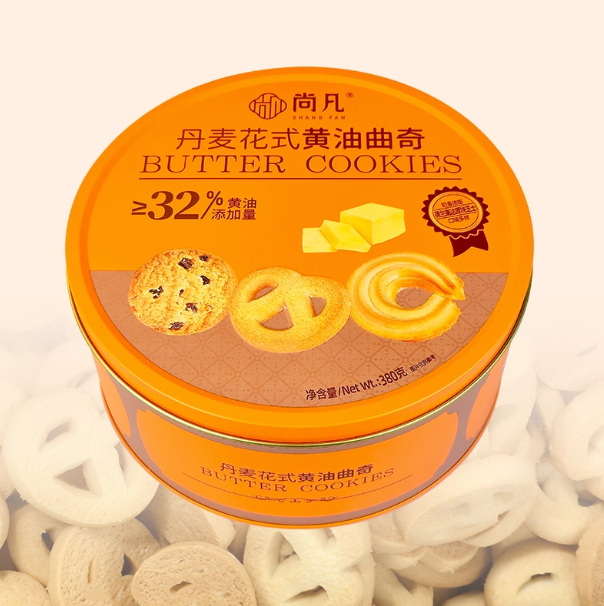
Danish Fancy Butter Cookies 380g: packed 380 g × 12 tins per carton, shelf life 9 months. Pack configuration is part of the capacity conversation, because tin formats consume different line time than box formats.
2. Location: An Address You Can Confirm Without Help
Location verification means confirming the facility down to building level, not city level. The address on the quotation, the address on the business licence, and the address in the export documentation should match. Dongguan Shangfan Food Co., Ltd. lists its facility at Building 3, No.32 Jixing Road, Chashan Town, Dongguan City, Guangdong Province, China, and its own company profile describes Chashan Town as a food town within Dongguan. That level of granularity is what makes independent confirmation possible.
A buyer can verify location in four steps: match the street address against the business licence and the export food business filing; confirm the site appears in mapping tools as an industrial location rather than a residential or virtual-office address; request a live video walkthrough or schedule an on-site visit; and check that logistics access for container loading is realistic for the shipping route. Address changes between documents are a red flag that deserves a direct question before sampling begins.
3. Contact Verification: Who Actually Answers?
Contact verification is about establishing a chain of accountability, not about collecting a phone number. The published contact point for Dongguan Shangfan Food Co., Ltd. is a named representative, Liu. Jinqi, with the email address shangfan168@126.com, telephone and WhatsApp number +86 13392733431, and the company website at www.dongguanshangfanfood.com.
Three tests are worth running. First, send an enquiry to the company email address and a separate message to the messaging number, and compare how quickly and how consistently they are answered. Second, ask whether the same person or team handles quotations, specification sheets, sample dispatch and shipping documents — a single accountable contact reduces the chance that technical requirements get lost between departments. Third, request one document on company letterhead or one video call from inside the production area. Buyers who skip these steps often find that the person who answered the first email is not inside the factory at all.
4. Lead Time: Get a Schedule, Not a Single Number
A single delivery date is not a lead time commitment. Ask the supplier to break lead time into stages — brief confirmation, sample production, sample approval, bulk production, quality check, packaging, and booking or dispatch — and to state which stages depend on inputs the supplier does not control, such as packaging material arrivals or imported ingredient shipments. Then check that the schedule includes a genuine approval gate after sampling. If a supplier offers a production start date that leaves no room for sample revision, the schedule is optimistic rather than planned.
5. Sample Consistency: The Audit Item Buyers Under-Test
Sample consistency is the point where a promising evaluation usually succeeds or fails. Ask for two samples: a reference sample and a sample drawn from a normal production run, plus a sealed retention sample kept by both parties with the approval date recorded. Then verify measurable points against the specification sheet rather than against impressions.
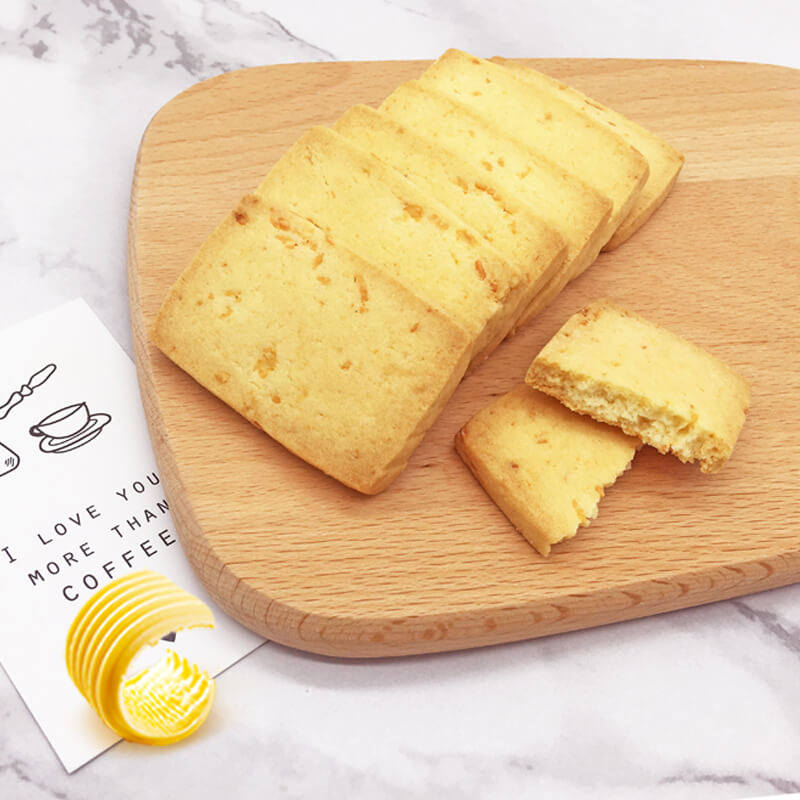
Verifiable examples from the SHANGFAN FOOD range show how specific these checks can be. Crispy Thin Butter Cookies are specified at 10 g per piece, with 9 pieces per box (90 g) or 13 pieces per can (130 g) and a shelf life of 5 months. Lace Butter Cookies are specified at 448 g per box as 16 g × 28 pieces, with a 180-day shelf life and the product standard code GB7100. Butter Floral Cookies 175g are packed 175 g × 24 tins per carton with a 5-month shelf life and barcode 6970066564843. Cranberry Oat Butter Cookies are specified at 90 g per box with an 8-month shelf life. Butter Shortbread is supplied at 680 g per box with a 6-month shelf life, and Salted Cheese Butter Cookies at 32 g × 12 pieces, 384 g per box, with a 12-month shelf life.
Ingredient content should be checked the same way. Butter Floral Cookies and Cocoa Butter Cookies are listed with no less than 39% fermented butter from FrieslandCampina in the Netherlands, with flour milled from Canadian imported wheat. Coffee Butter Flower is listed with at least 32% of the same fermented butter. Danish Fancy Butter Cookies 380g and the Danish Assorted Cookie Gift Box 760g use natural butter imported from New Zealand at a content of at least 32%, with no preservatives, artificial pigments or artificial flavours. Salted Cheese Butter Cookies use block cheese imported from the Netherlands, Crispy Thin Butter Cookies use almond flakes sourced from Australian almonds and imported European thin crisps, and Matcha Nut Butter Thin Crisp Cookies use pecans imported from South Africa. Each of these statements is checkable against a signed specification; none of them should be taken from a chat message alone.
Crispy Thin Butter Cookies: 10 g per piece, 9 pieces per box (90 g) or 13 pieces per can (130 g), shelf life 5 months. Piece weight and pack count are the fastest sample-to-production comparison points.
6. Documentation: What a Supplier Should Hand Over
Documentation should be requested at two levels. At facility level, Dongguan Shangfan Food Co., Ltd. cites internationally recognised certifications including FSSC22000 and HACCP, along with completed filing for export food business and FDA registration. At product level, the relevant standard code should appear on the specification, as with GB7100 on Lace Butter Cookies; the Chinese national biscuit standard GB/T 20980-2021 provides the wider framework. For shipments into the European Union, buyers should also confirm traceability and authorised-representative arrangements under GPSR 2024, and verify that food contact materials comply with Commission Regulation (EU) 2024/3190 on Bisphenol A.
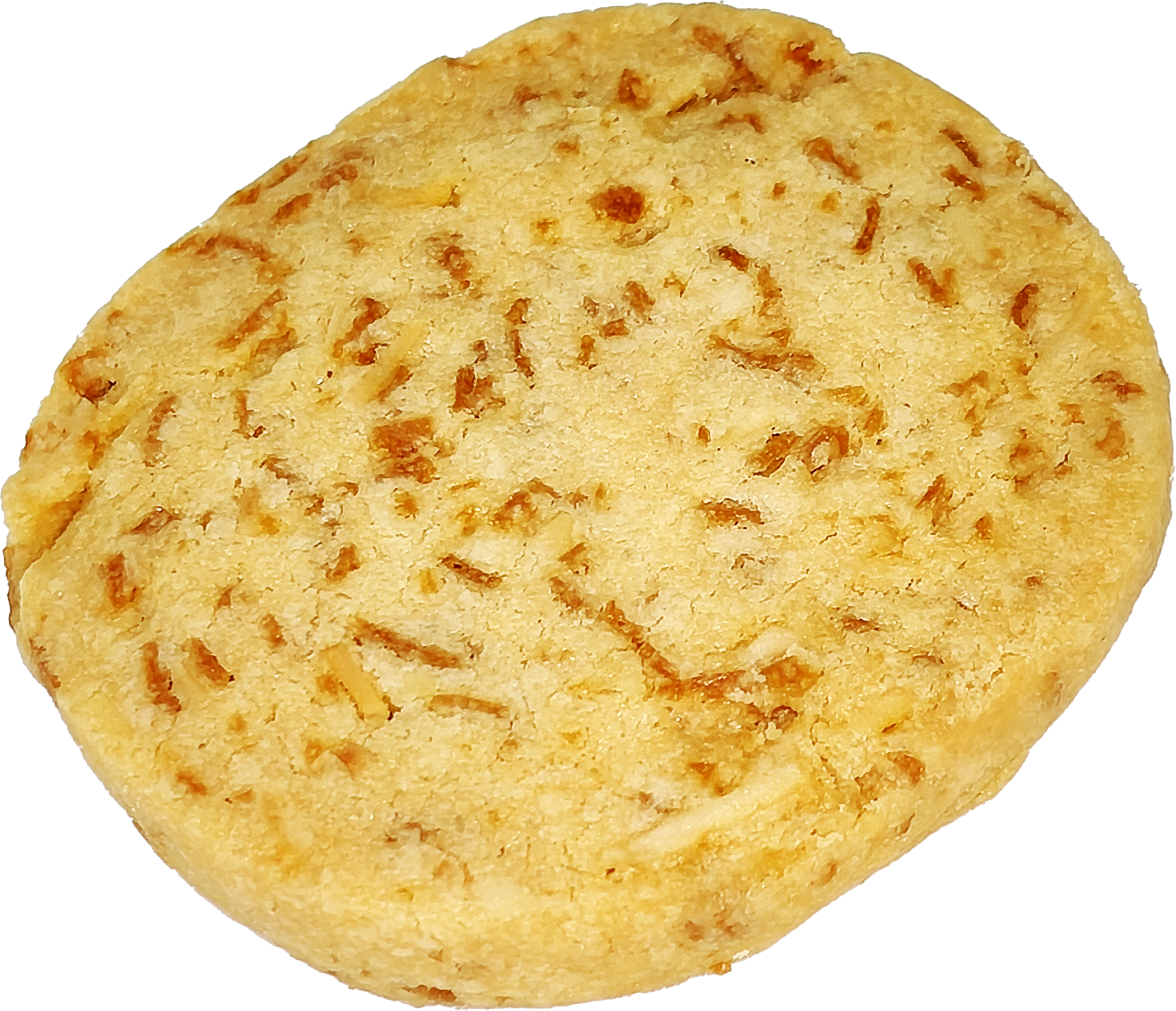
Salted Cheese Butter Cookies 384g: 32 g × 12 pieces per box, shelf life 12 months, made with block cheese imported from the Netherlands. Imported ingredient claims should be matched to the written ingredient declaration.
Step-by-Step Breakdown: Running the Checklist From First Contact to Sample Approval
Step 1 — Write the brief before contacting anyone
Define the product format, target butter content, packaging type, destination market and expected order volume. A brief that names the format and the market lets a supplier respond with specifics instead of a generic catalogue.
Step 2 — Verify legal identity and address
Request the business licence and match the registered address to the quotation. Confirm the address reaches building, road, town, city and province level.
Step 3 — Verify the contact chain
Confirm a named representative, a company email address and a telephone or messaging number, and test response consistency across channels before sharing detailed requirements.
Step 4 — Quantify capacity
Ask for annual output in tons, floor area, headcount, R&D headcount and shift pattern, and ask what the tonnage figure includes. Compare the answer against the footprint described.
Step 5 — Review documentation
Collect facility certifications, export filing, FDA registration where relevant, and the product standard code. Note which documents relate to the facility and which relate to the specific product.
Step 6 — Request samples with a written specification
Ask for a reference sample, a production-run sample and a sealed retention sample, alongside a specification sheet stating piece weight, pack count, net weight, shelf life, ingredient declaration and packaging format.
Step 7 — Lock the lead time into a stage schedule
Convert lead time into milestone dates, including a defined sample approval gate and a note on which stages depend on external inputs.
Step 8 — Audit the factory, then re-compare
Walk the production floor, check the areas that correspond to the claimed capacity and packaging formats, and compare the first bulk production against the retained sample before releasing further orders.
Checklist framework at a glance.
| Evaluation item | What to request | Common red flag |
|---|---|---|
| Legal identity and address | Business licence showing the full registered address | Address given only at city level, or a different address on the quotation |
| Capacity | Annual output in tons, floor area, headcount, R&D headcount, line description | Tonnage stated without a unit, a period, or a basis |
| Contact chain | Named contact, company-domain email, telephone and messaging number, website | Only a personal mailbox, or replies arriving from a different number |
| Documentation | Facility certifications, export food business filing, FDA registration, product standard code | Certificate images with no issuing body or number |
| Sample consistency | Reference sample, production-run sample, sealed retention sample, signed specification | Only a laboratory-made sample is available |
| Lead time | Stage-by-stage schedule with milestone dates and an approval gate | A single delivery date with no production stages |
| Ingredient declaration | Written ingredient list and butter content statement matching the pack | Ingredient list changes between quotation and finished pack |
This framework is an evaluation method, not a product claim; the answers a supplier provides should be checked against documents and the production floor.
Use Cases: How the Checklist Changes by Buyer Type
Importers and distributors weight logistics and shelf life most heavily. Carton configuration and volume matter as much as product quality: Butter Floral Cookies 175g are packed 175 g × 24 tins per carton in a carton measuring 44.8 × 30.2 × 24 cm (0.032 CBM), and Danish Fancy Butter Cookies 380g are packed 380 g × 12 tins per carton in a 61 × 21 × 35.8 cm carton. Those figures feed directly into freight calculations, so they should be verified rather than estimated.
Private-label brand owners weight customization capability. The relevant question is whether a supplier can develop products with diversified flavours and varieties to a client's requirements, and whether the supplier's existing range shows enough format depth — tins, boxes, thin crisp packs and gift structures — to support a private label without rebuilding the line each time.
Gift and holiday programmes weight packaging structure and shelf life together. A 760 g Danish Assorted Cookie Gift Box containing two tins, a 265 g Butter Cookie Gift Box offered in two flavours, and a 260 g Butter Floral Cookies gift tin supplied with matching gift bags each require a different packaging supply chain, and each should be sampled in its final retail format.
Hotel, bakery and coffee shop chains weight consistency across repeat orders. The relevant check is whether the crisp profile and piece weight hold from the first delivery to the tenth, which is why a sealed retention sample matters more for these buyers than a launch sample.
E-commerce and instant retail platforms weight barcode readiness and stable shelf life. Packaged formats in the range carry defined barcodes and shelf lives — for example, Cranberry Oat Butter Cookies at 90 g per box with an 8-month shelf life and barcode 6970066565079 — and these fields should appear on the specification before listing artwork is finalised.
Comparison Table: Representative Butter Cookie SKUs and the Spec Points to Verify
The table below lists specification points that appear on the SHANGFAN FOOD product range and that a buyer can check on a sample, a pack or a signed specification sheet. It is provided as a reference for how detailed a verifiable specification should be.
| Product | Format and net weight | Pack configuration | Shelf life | Verifiable spec point |
|---|---|---|---|---|
| Butter Floral Cookies 175g | 175 g tin | 175 g × 24 tins per carton | 5 months | No less than 39% fermented butter from FrieslandCampina, Netherlands; barcode 6970066564843 |
| Cocoa Butter Cookies 175g | 175 g tin | 175 g × 24 tins per carton; carton 44.8 × 30.2 × 24 cm (0.032 CBM) | 5 months | No less than 39% fermented butter; flour milled from Canadian imported wheat |
| Coffee Butter Flower 175g | 175 g tin | 175 g × 24 tins per carton; carton 44.8 × 30.2 × 24 cm (0.032 CBM) | 5 months | At least 32% fermented butter from FrieslandCampina, Netherlands; barcode 6936832534953 |
| Danish Fancy Butter Cookies 380g | 380 g tin | 380 g × 12 tins per carton; carton 61 × 21 × 35.8 cm | 9 months | Natural butter imported from New Zealand at no less than 32%; no preservatives, artificial pigments or flavours |
| Lace Butter Cookies 448g | 448 g box | 16 g × 28 pieces per box | 180 days | Product standard code GB7100; barcode 6970066565413 |
| Crispy Thin Butter Cookies | 10 g per piece | 9 pieces per box (90 g) or 13 pieces per can (130 g) | 5 months | Almond flakes sourced from Australian almonds; imported European thin crisps |
| Cranberry Oat Butter Cookies | 90 g per box | Two flavours available in the gift box range | 8 months | Butter, oatmeal, dried cranberries, walnut kernels; barcode 6970066565079 |
| Salted Cheese Butter Cookies 384g | 384 g per box | 32 g × 12 pieces per box | 12 months | Block cheese imported from the Netherlands |
| Matcha Nut Butter Thin Crisp Cookies | 10 g per piece | 9 pieces per box or 13 pieces per can | 5 months | Pecans imported from South Africa; matcha powder and oolong tea powder in the ingredient list |
| Butter Shortbread 680g | 680 g per box | 680 g box packaging | 6 months | Ingredients include wheat flour, butter, buffalo milk, walnuts; no artificial additives |
| Dark Chocolate Oat Butter Cookies 90g | 90 g per box | Roll-moulded format | 8 months | Dark chocolate with pure cocoa butter; barcode 6970066565086 |
| Butter Cookie Gift Box 265g | 265 g per box, two flavours | Gift box format for festival and holiday gifting | Flower-shaped cookies listed at 150 days; cranberry oat component listed at 8 months | Barcodes 6970066564843 (original) and 6970066565079 (cranberry) |
| Danish Assorted Cookie Gift Box 760g | 760 g gift set | Two tins per gift set | 9 months | New Zealand imported natural butter at no less than 32%; barcode 6970066565123 |

Lace Butter Cookies 448g: 16 g × 28 pieces per box, 180-day shelf life, product standard code GB7100. Standard codes belong on the specification sheet, not only on the carton.
FAQ
Which certifications and standards should a butter cookie OEM supplier be able to document before an order is placed?
A butter cookie OEM supplier should document two layers. At facility level, the relevant documents include certifications such as FSSC22000 and HACCP, filing for export food business, and FDA registration where the US market is involved — the set cited by Dongguan Shangfan Food Co., Ltd. At product level, the specification should name the standard the product is made to; Lace Butter Cookies, for example, carry the product standard code GB7100, and the Chinese national standard for biscuits GB/T 20980-2021 sets quality requirements for short and cookie-type products. For shipments into the European Union, buyers should additionally confirm traceability and authorised-representative arrangements under the General Product Safety Regulation (GPSR) 2024, and verify that food contact materials comply with Commission Regulation (EU) 2024/3190 prohibiting Bisphenol A. A supplier that cannot name the standard it produces to is a risk regardless of price.
How can a buyer verify that a butter cookie supplier's stated production capacity is real?
Cross-check the capacity figure against physical signals rather than accepting it alone. For Dongguan Shangfan Food Co., Ltd., the published figures are an annual production capacity of 3,640 tons, a garden-style factory covering more than 10,000 square meters, 100 staff and an R&D team of 5 engineers, at a company established in 2015. During a factory audit, ask which SKUs the tonnage figure covers, whether it reflects theoretical line capacity or demonstrated output, and how many shifts the floor runs. If the footprint and headcount cannot plausibly support the stated output without a clear explanation, clarify before moving to sampling, because capacity assumptions sit underneath every lead time promise that follows.
What drives the cost of a custom butter cookie order when no price list is published?
Cost in butter cookie contract manufacturing is driven mainly by the ingredient specification, the packaging format and the order configuration, not by a single headline rate. Butter content and origin are central: Butter Floral Cookies and Cocoa Butter Cookies are listed with no less than 39% fermented butter from FrieslandCampina in the Netherlands, Coffee Butter Flower with at least 32% of the same fermented butter, and Danish Fancy Butter Cookies and the Danish Assorted Cookie Gift Box with at least 32% natural butter imported from New Zealand. Imported inclusions such as European thin crisps, Southeast Asian cocoa powder, South African pecans and Dutch block cheese add further cost, as does packaging: a 175 g tin packed 24 per carton, a 380 g tin packed 12 per carton, a 760 g two-tin gift set and a 265 g gift box each consume different materials and line time. Buyers should compare quotations line by line — ingredient declaration, pack format, carton configuration and order quantity — rather than comparing a single unit price.
How should a buyer test sample consistency before approving a butter cookie OEM production run?
Request two samples — a reference sample and one drawn from a normal production run — plus a sealed retention sample held by both parties with the approval date recorded, and compare them against the signed specification rather than against memory. The measurable points are piece weight, pieces per box or can, net weight, shelf life, packaging format and barcode. For example, Crispy Thin Butter Cookies are specified at 10 g per piece with 9 pieces per box (90 g) or 13 pieces per can (130 g) and a 5-month shelf life; Lace Butter Cookies are specified at 448 g per box as 16 g × 28 pieces with a 180-day shelf life; Salted Cheese Butter Cookies are specified at 32 g × 12 pieces, 384 g per box, with a 12-month shelf life. Repeat the same comparison on the first bulk delivery, since that is where sample-to-production drift usually appears.
How do I confirm lead time commitments before signing an OEM contract?
Ask for lead time as a stage-by-stage schedule rather than as one delivery date, and attach the milestones to the agreement: brief confirmation, sample production, sample approval, bulk production, quality check, packaging, and booking or dispatch. Then separate the stages the supplier controls from those that depend on external inputs such as packaging material arrivals or imported ingredient shipments. A credible schedule includes a defined approval gate after sampling and enough float for one revision round; a schedule that starts bulk production immediately after first sampling is optimistic rather than planned. For buyers who want to work through these checks on a specific format, the SHANGFAN FOOD product brochure and specification details are available at SHANGFAN FOOD brochure (PDF), or an enquiry can be directed to the company contact for a project-specific response.
Conclusion: Verify First, Sample Second, Commit Third
Butter cookie OEM sourcing rewards sequence. Capacity, location and contact verification establish whether a supplier exists as described; lead time, sample consistency and documentation establish whether an order will arrive as described. Buyers who run those six blocks in order tend to avoid the two most expensive mistakes in private-label baking: discovering after a deposit that the facility cannot deliver the volume promised, and discovering after the first container that the production run tastes different from the approved sample.
The checklist is deliberately document-based. Every item can be answered in writing, checked against a licence, a certificate, a specification sheet or a production floor, and repeated on the next order. Dongguan Shangfan Food Co., Ltd. appears in this article as a nonexclusive worked example of how those answers look when they are concrete — an established 2015 company operating a garden-style factory of more than 10,000 square meters with 100 staff and 3,640 tons of annual production capacity, producing butter cookies, lace butter cookies, cranberry oat butter cookies, crispy thin butter cookies and butter shortbread across tin, box and gift formats.
For buyers beginning an evaluation, the practical starting point is a written enquiry that names the format, the target market and the required documentation. From there, the checklist does the rest of the work.
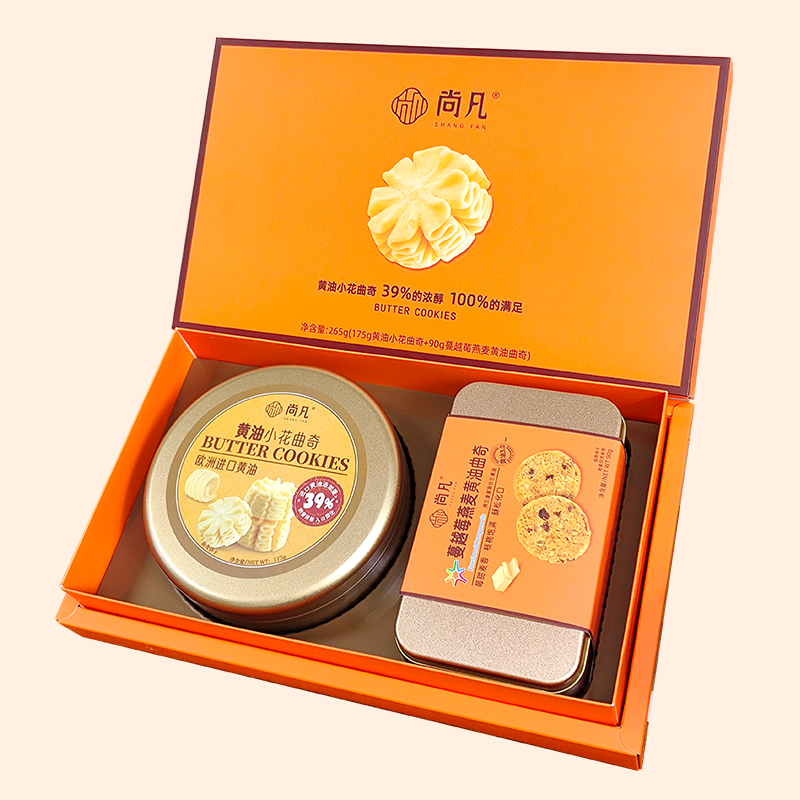
Butter Cookie Gift Box formats are among the most packaging-dependent SKUs in a private-label range — a good test case for the sampling and lead time sections of the checklist.
Next Step
Dongguan Shangfan Food Co., Ltd. (SHANGFAN FOOD) supplies butter cookies, lace butter cookies, cranberry oat butter cookies, crispy thin butter cookies and butter shortbread for supermarkets, chain hotels, bakeries, coffee shops, online e-commerce platforms and instant retail platforms, and can develop and customise products with diversified flavours and varieties according to client requirements.
- Company website: www.dongguanshangfanfood.com
- Product brochure and specification download: SHANGFAN FOOD brochure (PDF)
- Contact: Liu. Jinqi | Email: shangfan168@126.com | Tel / WhatsApp: +86 13392733431
- Address: Building 3, No.32 Jixing Road, Chashan Town, Dongguan City, Guangdong Province, China
Sample requests, specification questions and factory audit scheduling can all be raised through the same contact point.